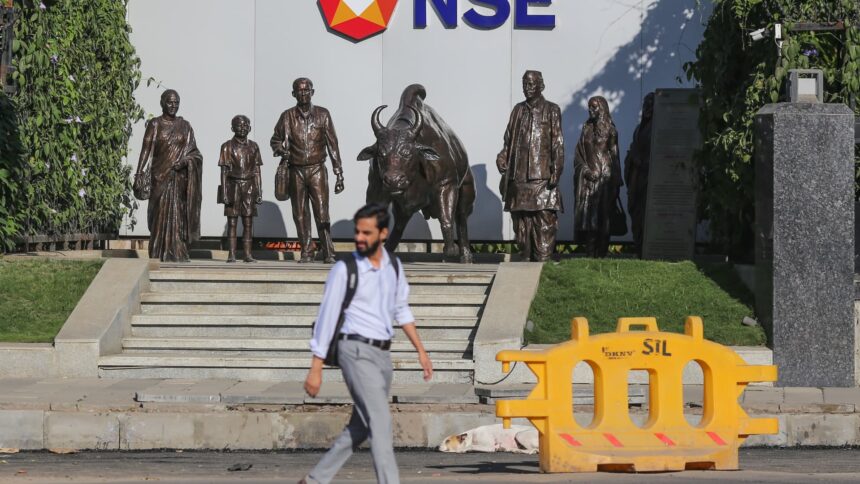
The landscape for initial public offerings (IPOs) in India is currently under significant strain as global volatility weighs heavily on market confidence. Amid this turbulence, the payments app PhonePe recently suspended its listing plans, highlighting the challenges facing the country’s bustling IPO environment. Since January, Indian benchmark indices have suffered a drop of over 12%, largely attributed to the economic repercussions of ongoing conflicts in the Middle East, which have led to energy shortages and disruptions in trade.
The rupee’s continued decline against the dollar has compounded these issues, with foreign institutional investors pulling out more than $8 billion from Indian equities in just the first few weeks of October. This risk-averse sentiment among investors has diminished liquidity in the primary market, making it increasingly difficult for potential IPOs to achieve the high valuations that have traditionally driven them.
Prominent players in the Indian tech and consumer startup sectors, including Walmart-backed PhonePe, quick-commerce service Zepto, e-commerce giant Flipkart, and hospitality firm Oyo, have decided to defer their IPO plans amid concerns over valuation mismatches. Samir Bahl, the CEO of investment banking at Anand Rathi Advisors, noted that companies like Zepto and Oyo had already filed for IPOs confidentially with substantial capital goals, but are now reconsidering their timelines.
In a recent statement, PhonePe emphasized that its decision to pause its listing is a direct response to the “current geopolitical conflicts and market volatility.” Large-scale IPOs, including those anticipated from key players like NSE and telecoms leader Reliance Jio, will likely proceed only when market conditions stabilize, according to Bahl, who underlined the need for careful consideration of timing and pricing.
Looking ahead, Reliance Jio is reportedly preparing for its IPO in the first half of 2026, while the NSE has appointed a team of 20 merchant bankers to facilitate its own upcoming offering. However, the overall sentiment toward IPOs has soured significantly since the onset of the Iran conflict, leading many investors to retreat from the market.
The Indian IPO market experienced unprecedented activity over the past two years, leading the globe with 367 listings in 2025, as highlighted in a recent EY report. However, recent poor performance has left retail and high-net-worth investors hesitant to engage, with eight of the eleven IPOs launched this year trading below their original offering prices.
Experts suggest that retail investors are unlikely to return until market returns show notable improvement. Bahl noted that only a handful of companies are moving forward with IPOs due to immediate funding needs or regulatory pressures. Meanwhile, engagement from foreign institutional investors has fallen sharply, with participation in IPOs dropping from nearly $1.5 billion in early 2025 to around $820 million this year, according to NSDL data.
Domestic institutional investors, buoyed by a streak of consistent equity inflows, are now dominating the pricing landscape, exerting pressure on companies to justify their valuations. As the current market climate remains unsettled, the future of India’s IPO market hinges on geopolitical developments and economic recovery.