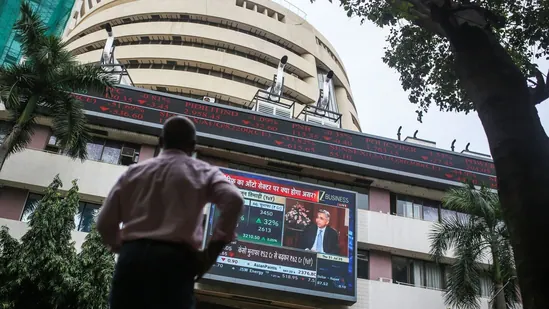
India’s stock markets exhibited a mixed performance as investors reacted to the US Federal Reserve’s decision to implement a third consecutive interest-rate cut. The central bank reduced the federal funds rate by 25 basis points, bringing it to a range of 3.5-3.75 percent. This move, announced during the Fed’s December meeting, was seen in the context of ongoing struggles with the US-India trade negotiations that have lingered without significant progress.
On Thursday, the 30-share BSE Sensex started the day modestly, gaining 0.17% before reversing direction and trading 0.26% lower. Similarly, the NSE Nifty 50 witnessed a brief uptick of 45.05 points, which was soon overshadowed by a slip of 50.90 points shortly thereafter. Wall Street had recorded a higher close, reflecting a degree of optimism following the Fed’s announcement, yet Indian markets struggled to maintain momentum.
Market analysts pointed to significant selling pressure from foreign institutional investors (FIIs) as a crucial factor in the lackluster performance of Indian equities. Ponmudi R., Chief Executive of Enrich Money, highlighted concerns regarding the delayed progress in the India-US trade discussions, alongside persistent weakness in the Indian rupee, which prompted profit booking among investors.
G. Chokkalingam, founder and head of research at Equinomics Research, also commented on the situation, indicating that while the rate cut by the Federal Reserve might not drastically impact Indian markets, liquidity issues created by a surge in initial public offerings (IPOs) were a significant barrier. He suggested that a reduction in IPO activity would be necessary for sustained market gains.
The Indian stock market is currently grappling with two main challenges: ongoing selling by FIIs, compounded by the lack of advancement in the India-US trade dialogues, and disappointing corporate earnings that have trended downward over the past six quarters. Latest stock exchange data showed that net FII outflows amounted to ₹1,651 crore, contrasted with net domestic institutional investor (DII) inflows of ₹3,752 crore. Throughout the year, FIIs have exited Indian equities worth ₹2.72 lakh crore, while domestic investors capitalized on the record-breaking IPO boom, investing ₹7.33 lakh crore.
In the foreign exchange sector, the Indian rupee weakened by 17 paise, trading at 90.11 against the US dollar in early Thursday sessions. This depreciation was attributed to risk-averse market sentiments and heightened demand for dollars from importers. Analysts have suggested that the rupee may continue to experience negative pressure given the lackluster performance of domestic markets and ongoing foreign fund outflows.
Amidst the backdrop of the Fed’s rate cut, Anil Kumar Bhansali, head of treasury at Finrex Treasury Advisors LLP, provided insight into future currency movements. He noted that while the US trade team has indicated a potentially favorable proposal from India, the rupee could face further depreciation once the trade deal is finalized.
Rajeev Sharan, from Brickwork Ratings, reiterated that although the Fed’s balanced outlook subdued concerns about a hawkish stance, the rate cut alone is insufficient to mitigate ongoing structural challenges facing the Indian rupee, particularly regarding heightened tariffs and rising US yields. As markets and investors await developments in trade negotiations, both equity and currency landscapes appear to remain precarious.