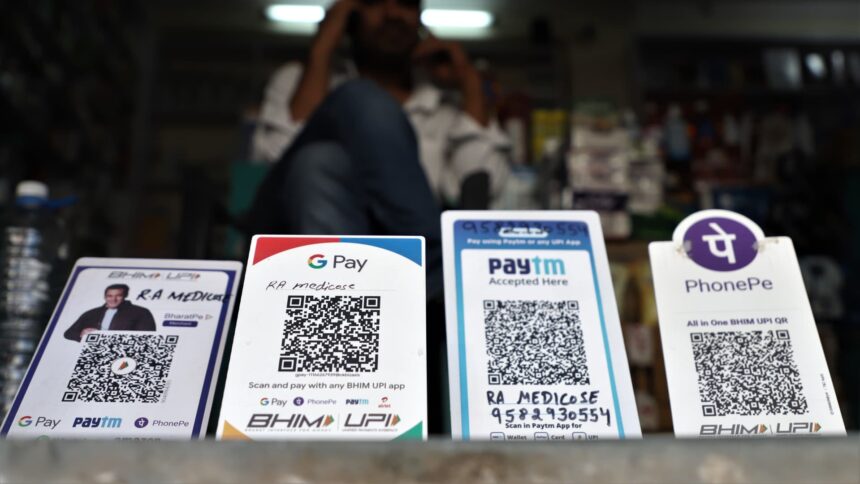
In a significant development at the Global Fintech Fest held at Mumbai’s Bandra Kurla Complex, India’s cashless payment system, the Unified Payments Interface (UPI), is making waves not only domestically but also on the global stage. With delegates navigating through traffic congestion and connectivity issues typical of India’s financial hub, the convergence of innovation showcased at the event highlighted how money transfers have been revolutionized. Through this interface, sending money has become as seamless as exchanging messages on WhatsApp.
The spotlight of the event was undoubtedly on PayPal, which announced the integration of UPI into its World platform, enabling international transactions for the first time. PayPal CEO Alex Chriss emphasized India’s burgeoning reputation as a hub of talent, capital, and business opportunities, calling the unfolding scenario a part of India’s broader fintech diplomacy. Just a day prior, Indian Commerce Minister Piyush Goyal launched UPI in Qatar, marking it as the eighth international destination for this payment system and asserting the intention to boost trade relations between the two countries.
With UPI processing an astounding 640 million transactions daily—outnumbering Visa’s 639 million—its international expansion is rapidly becoming an economic strategy rather than merely a technological advancement. The Indian government’s push to launch UPI in more than 20 countries by March 2029 aims to redefine cross-border remittances.
In the context of the rising international presence of Indian travelers—30.8 million Indians went overseas in 2024, a jump of 10.8% from the previous year—money transfer platforms are seeing increased demand for streamlined services. With remittances projected to rise, India garnered an astonishing $129 billion in remittances in 2024, according to World Bank estimates, solidifying its position as the top recipient among developing nations.
Experts believe that UPI’s interoperability with other digital payments platforms will not only simplify international transactions but also provide an economic advantage by cutting remittance costs significantly. Traditional banks often impose hidden fees that inflate transaction costs. By leveraging UPI’s infrastructure, the Indian government aims to reduce these expenses, benefiting both senders and receivers of remittances while also supporting the country’s balance of payments.
However, remittances play a critical role as they mitigate the current account deficit (CAD), which is projected to be around 1.2% of GDP in the current financial year. With UPI’s international rollout, the association with frameworks like PayNow in Singapore and PromptPay in Thailand is already yielding promising results.
In addition to the financial sector’s developments, other noteworthy announcements include Google’s $15 billion investment in a new data center hub in India aimed at enhancing artificial intelligence capabilities. Meanwhile, LG Electronics India has recently outperformed its parent company in market capitalization following a highly successful IPO.
Overall, the expansion of UPI represents a substantial leap in India’s digital payment landscape, heralding a shift in how financial transactions are conducted both within the country and across borders. This progress is being closely monitored, not only for its economic implications but also for its potential to enhance India’s standing in the global fintech ecosystem.