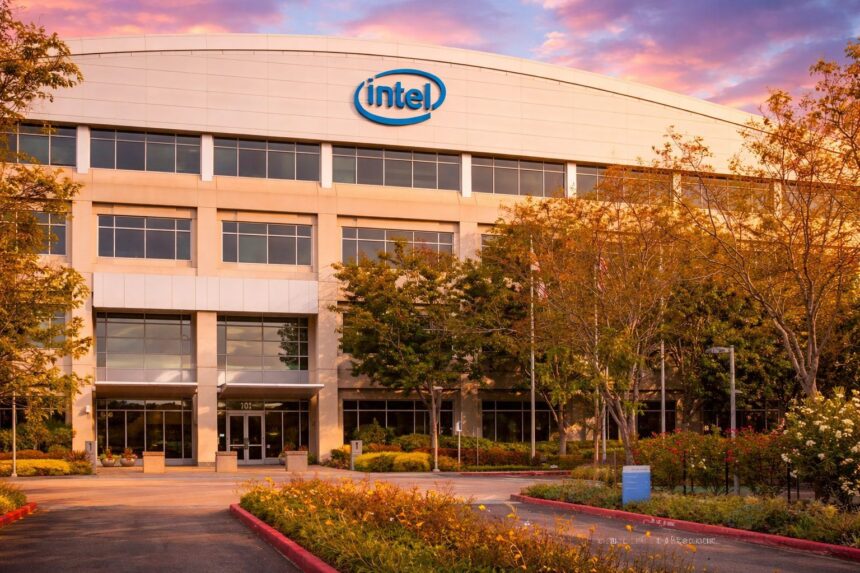
Intel Corporation concluded the regular trading session on Friday with a modest increase in its share price, building on its gains in after-hours trading as investors reacted to significant regulatory news concerning Nvidia’s proposed investment in the company.
By the end of Friday’s trading, Intel shares rose to $36.82, marking a 1.49% increase during the day. The stock continued to gain momentum post-market, trading around $37.10 by 6:02 p.m. ET, a further increase of approximately 0.76%. Observers noted unusually high trading volumes in the after-hours session, indicative of strong investor activity as market participants prepared for the upcoming week.
This positive trend followed a broad rally in U.S. equities, fueled particularly by renewed interest in significant AI and semiconductor stocks—a critical backdrop for analysts and traders as they approached the next trading day on Monday, December 22, when the markets would reopen after the weekend closure.
The market’s reaction was largely influenced by a key regulatory development: the Federal Trade Commission (FTC) announced clearance for Nvidia’s $5 billion investment in Intel, a move that had previously raised concerns among investors. The absence of regulatory hurdles mitigates what could have been a significant risk factor, allowing the market to shift focus towards execution and operational execution rather than pending approvals. This shift in focus could potentially reassure investors about the funding stability and foundry roadmap crucial for Intel’s future initiatives.
Nvidia’s investment strategy, unveiled earlier in September, sought to solidify a partnership with Intel that would span collaborative efforts in both PC and data center chips, with the possibility of Nvidia becoming a major customer for Intel’s foundry services. The investment was seen as a vote of confidence for Intel as it has been striving to solidify its manufacturing credibility amidst ongoing challenges.
Despite Intel’s positive closing, its performance paled in comparison to other semiconductor giants, such as Nvidia and Broadcom, which saw their share prices increase by more than 3%. Analysts attributed this disparity to Intel’s current standing; it remains perceived as a company needing to prove its execution capabilities, contrasting with the more immediately favorable outlook for Nvidia and Broadcom, which are viewed as beneficiaries of current AI infrastructure spending.
In terms of analyst sentiment, Intel’s stock is currently caught in a dichotomy of opinions. A recent MarketBeat report suggested a “Reduce” consensus rating with a target price around $34.84, while TipRanks conveyed a more neutral “Hold” stance with a higher average target near $37.25. This discord among analysts highlights the prevailing uncertainty regarding Intel’s future performance and the potential for the stock to either rally further or face downward pressure based on execution results.
Looking ahead into the next trading session, several factors warrant monitoring. Market participants should pay attention to any follow-up developments regarding Nvidia’s investment timeline and structure, as well as Intel’s ability to maintain its post-market levels around $37.00. Technical indicators also suggest that investors will keep an eye on established moving averages, with key levels around $38 potentially acting as points of resistance or pivotal breakout zones.
With the Christmas week approaching—a period typically characterized by thinner liquidity—traders should remain vigilant, as this could lead to amplified price movements. Additionally, the sentiment surrounding AI and tech stocks appears to be recovering, indicating a potential “Santa rally,” a phenomenon that often influences market dynamics during late December.
Ultimately, as Intel navigates this pivotal moment, the market will closely watch how it responds to the lifted regulatory burden and whether it can convert collaborative efforts into sustained growth and revenue as it attempts to close the gap to its 52-week high. Investors will need to weigh both the opportunities that arise from the Nvidia partnership against the backdrop of mixed analyst forecasts and broader economic conditions.