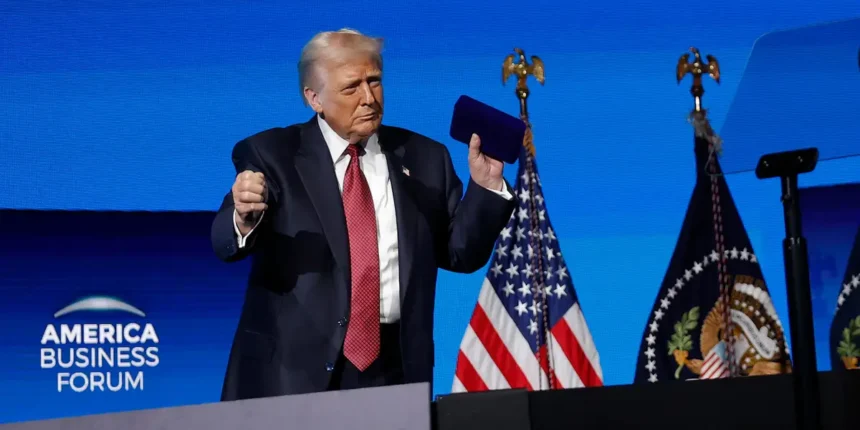
In the aftermath of the 2024 U.S. presidential election, the financial world witnessed a notable phenomenon dubbed the “Trump Trade.” Following Donald Trump’s victory, investments in cryptocurrency, U.S. stocks, and the dollar surged. However, the bond market exhibited caution, resulting in a sell-off. Investors are now reassessing the accuracy of their predictions based on this trade, which included five major components.
Cryptocurrency: Investors who placed their bets on cryptocurrencies have largely been vindicated. Over the past year, major digital assets have experienced significant increases in value. Bitcoin, for instance, rose by 36% overall, with a peak growth of 67%. Ethereum showed gains of 23%, with a high of 78% at one point. Similarly, shares of Coinbase skyrocketed by 87% in early November, maintaining an 18% increase thereafter. Trump’s pro-crypto stance was evident during his campaign, and he has since taken steps that bolstered investor confidence. He dismantled the crypto fraud investigations team at the Justice Department, created a strategic bitcoin reserve, and issued an executive order to prevent the establishment of a central bank digital currency. Notably, his decision to pardon Binance CEO Changpeng Zhao signaled an end to what Trump described as the Biden administration’s “war on crypto.”
U.S. Stocks: Regarding U.S. equities, the reception has been mixed. The S&P 500 index saw a 13% rise, though the journey was rocky. Initially, investor optimism stemmed from anticipated lower taxes and reduced regulation. However, this was offset by higher tariffs and macroeconomic uncertainties. An early tariff announcement by Trump led to a swift drop in the S&P 500, which lost 12% within days. While the market eventually rebounded, average tariff levels remained unexpectedly high at 15% to 20%. Interestingly, while Trump emphasized fossil fuel exploration, the oil sector saw a decline of 9%, in stark contrast to the 42% gain in renewable energy stocks.
International Stocks: Investors who shorted international stocks based on expectations of a business-friendly Trump administration faced disappointment. Contrary to predictions of a stagnant international market, stocks from abroad outperformed U.S. equities, buoyed by Trump’s trade policies and increased European government spending. Over the last year, international assets like the iShares MSCI Emerging Markets ETF rose by 22%, while the iShares MSCI EAFE ETF climbed 18%.
Tesla: Investors betting on Tesla made a sound decision. CEO Elon Musk’s close ties to Trump and financial backing provided optimism. While the stock experienced volatility, those who retained their investments benefitted from a remarkable 57% increase.
Bonds: The bond market’s response was to anticipate rising inflation and interest rates, resulting in a sell-off post-election. Yields on 10-year Treasury bonds jumped significantly on the day after the election. Although yields initially rose, they have since settled near 4%. Consequently, while the rationale for selling bonds was sound, those who did so missed further gains over the year. Trump himself has noted that he views bond yields and borrowing costs as a critical performance metric.
Overall, the landscape of the Trump Trade has proven complex and multifaceted, with varying degrees of success across different asset classes over the past year. Investors continue to navigate the intricate interplay between policies and market responses as they assess the future.