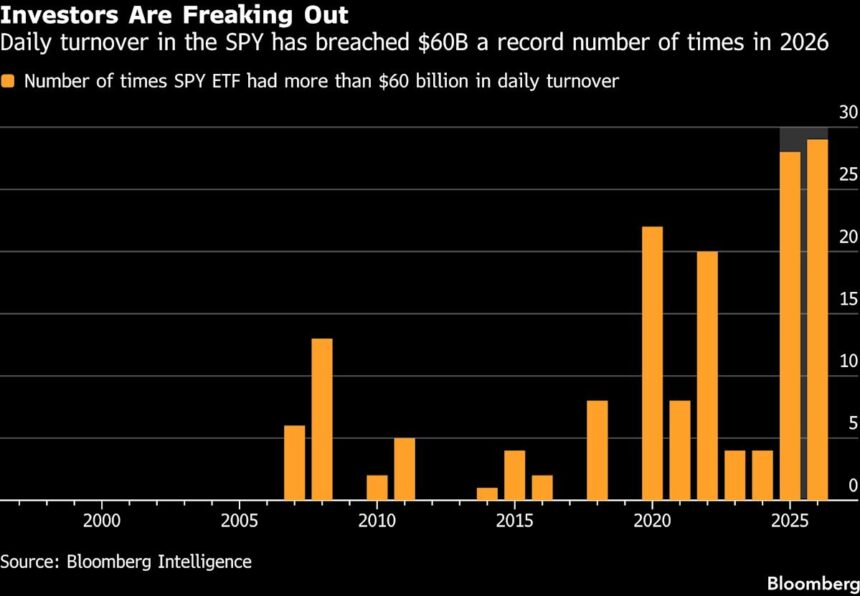
Investors are increasingly anxious amid the ongoing conflict in the Middle East, particularly in light of the situation between the U.S. and Iran. Recent trading activity indicates a heightened sense of urgency among traders, with daily turnover in the State Street SPDR S&P 500 ETF Trust surpassing $60 billion. This level of trading intensity has become a concerning trend, occurring 29 times this year alone, compared to just 28 instances throughout all of 2025, according to Bloomberg Intelligence strategists.
Market volatility was prominently displayed earlier this week when the S&P 500 Index experienced a 1.2% decline following President Trump’s intensified remarks against Tehran regarding the Strait of Hormuz. However, the index managed to recover and close slightly higher after news broke of a two-week ceasefire between the U.S. and Iran, momentarily alleviating some market tensions.
While the ceasefire may offer short-term relief to traders, analysts warn that uncertainty remains. Stuart Kaiser, head of U.S. equity trading strategy at Citigroup, pointed out that while the pause in military actions is a positive development, the long-term implications depend heavily on the actions of both the U.S. and Iran. “The details and durability of this agreement are significant sources of uncertainty,” he noted.
The ongoing turbulence appears to be affecting investor sentiment. Retail investors, who typically express bullish behavior, are showing signs of hesitation, while hedge funds have been liquidating global stock holdings at an unprecedented rate, marking the fastest sell-off in over a decade. Data indicates that dip-buyers are becoming increasingly cautious; a recent study revealed that investors are less likely to buy aggressively when the market experiences downturns.
Bloomberg Intelligence strategist Athanasios Psarofagis commented, “With each piece of bad news, the market reacts more dramatically than before, prompting many to decide it’s time to exit.” Historically, the market has often rebounded after declines triggered by external issues, and there is still a belief among some investors that the resilience of the U.S. economy and advancements in artificial intelligence could provide a supportive backdrop for stocks.
Seasonality could also play a role, as historical data shows the S&P 500 has averaged a gain of 1.5% in April since 1990, second only to November. There’s a belief that moments of market turmoil, akin to last year’s tariff-induced dips, could present valuable buying opportunities for prudent investors willing to navigate the risks.
As market participants continue to parse through the geopolitical landscape, it remains to be seen how long the ceasefire will hold and what implications this may have for the broader market outlook.