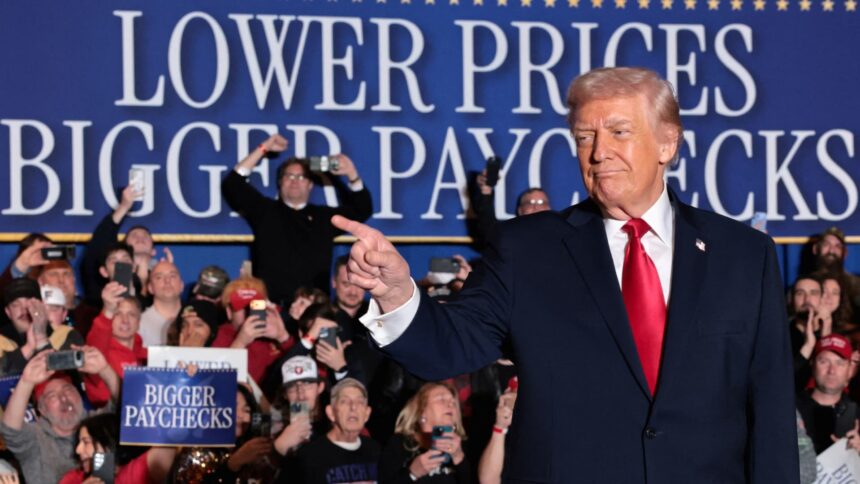
U.S. President Donald Trump has recently stepped into the spotlight at Mount Airy Casino Resort in Pennsylvania, emphasizing his administration’s ongoing focus on economic affordability amidst mounting tensions in the Middle East. The upcoming midterm elections, scheduled for November, are set to be influenced heavily by these developments, particularly as rising costs for everyday goods and services dominate public discourse.
As the U.S. escalates its military involvement in Iran, many are predicting significant economic ramifications that could shift voter sentiments heading into the elections. The emphasis from both parties has been on addressing affordability, yet the war threatens to complicate these discussions. Democrats are positioning themselves to capitalize on any perceived failures related to Trump’s foreign policy, arguing that the conflict could lead to increased living costs for ordinary Americans.
Senator Martin Heinrich of New Mexico highlighted the unforeseen economic consequences of the conflict during an interview, referencing the surge in oil prices since hostilities began. Specifically, crude oil prices have skyrocketed, climbing above $90 per barrel from approximately $67, propelling gas prices upwards of $3.38 per gallon, representing a 35-cent increase in just a week. Liquefied natural gas prices have also fluctuated due to global supply challenges, notably a recent shutdown in Qatar.
Democratic representatives have pointed out that while U.S. energy prices may have seen only modest increases, the overall impact on household utility bills remains substantial. Representative Jared Huffman from California emphasized that families have been feeling the strain of rising energy costs, particularly as natural gas—an essential component for electricity generation—becomes more expensive.
Looking ahead, some Republicans express optimism that a rapid resolution in Iran could stabilize energy prices. Senator John Hoeven of North Dakota believes that neutralizing Iran’s military capabilities could lead to a decrease in oil prices, allowing for uninterrupted shipments from the Arabian Gulf. However, doubts linger about whether the conflict can be resolved swiftly, posing challenges for GOP messaging regarding economic affordability.
Political analysts suggest that any sustained conflict could hinder the Republican party’s chances in the midterms. Brittany Martinez, a former aide to House Speaker Kevin McCarthy, noted that volatile energy prices would complicate the GOP’s narrative on affordability, as the party aligns itself with foreign policy strengths while Democrats highlight any economic fallout from military actions.
The public sentiment around military intervention is notably negative, with recent polls indicating that nearly 60% of respondents disapprove of U.S. action in Iran. Concurrently, Trump’s economic approval ratings remain low, with significant disapproval from voters regarding his handling of economic issues.
Democrats are keen to use this sentiment to illustrate what they view as Trump’s broken promises regarding foreign policy and his commitment to prioritizing American families over military engagements. House Democratic Caucus Chair Pete Aguilar reiterated the Democrats’ responsibility to inform the public of the costs associated with the war, especially as these financial commitments compete with domestic needs.
On the opposing side, some Republican candidates remain optimistic about their party’s ability to convey an effective message surrounding affordability despite the turmoil in Iran. Representative Zach Nunn from Iowa pointed to legislative successes in energy and housing as indicators of Republican efforts to address cost-of-living concerns.
As the midterm elections approach, the complexities introduced by foreign policy and economic realities will play a crucial role in shaping the political landscape, with both parties maneuvering to secure votes as Americans weigh their everyday economic struggles against broader geopolitical issues.