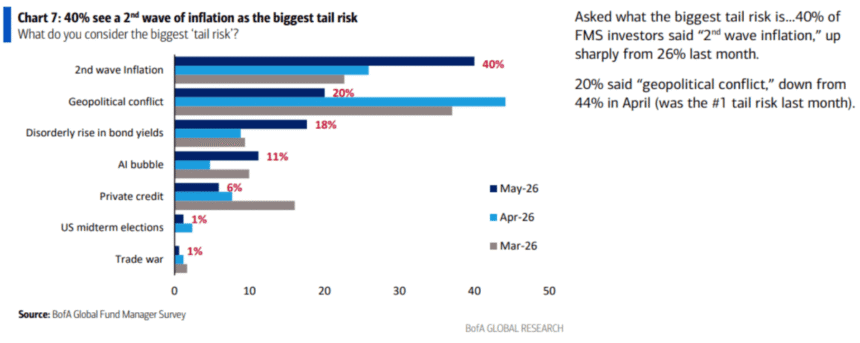
Recent data from Bank of America highlights inflation as a prominent concern, citing it as the biggest risk impacting the stock market. With inflation currently at 3.8% in the United States, analysts believe this economic condition could lead to a decline in share prices. However, investors who are well-prepared might not need to panic.
In response to the inflationary pressures, there are strategies that investors can adopt to safeguard their portfolios. One common approach is hedging, which involves purchasing assets expected to gain value should inflation persist. Typically, inflation dampens bond prices since fixed returns become less valuable in real terms. Consequently, investors might consider shorting long-term government bonds, such as the 20-year US Treasury bond, through options on ETFs like the iShares 20+ Year Treasury Bond ETF. While this method is often suited for professional fund managers, it may prove complicated for everyday investors.
Ordinary investors possess distinct advantages during market downturns. Unlike institutional investors, who face pressure from clientele to shift strategies after poor performance, regular investors can adopt a patient approach. This perspective aligns with Warren Buffett’s philosophy that the stock market facilitates a transfer of wealth from the impatient to the patient. Unfortunately, many retail investors risk undermining this advantage by mimicking professional strategies, thereby converting potential opportunities into challenges.
Despite the benefits of patience, disregarding the risk of a market crash entirely would be imprudent. Thus, what should everyday investors focus on? An analysis of businesses that benefit from inflation reveals key insights. For instance, Wise, a cross-border payment platform, stands to gain from increased transaction volumes as prices rise. The company’s revenue model, which relies on a fixed percentage from transactions, positions it favorably in an inflationary landscape. Furthermore, Wise leverages its scale to minimize costs and can offer competitive pricing, making it a formidable player in its sector.
Currently, Wise’s stock appears undervalued, particularly following its recent transition to a primary listing on the Nasdaq to attract a broader base of investors. Despite its stock dropping 14.5% since this listing, some analysts view this as a potential investment opportunity.
Investment expert Mark Rogers, known for his successful Twelfth Magpie Share Advisor newsletter, suggests that now could be a pivotal moment to explore stocks like Wise Plc, among others that his team identifies as worthy of consideration.
Investors are urged to conduct thorough research before making any decisions. The dynamic interplay between inflation and market behavior necessitates careful analysis and strategic planning for both retail and institutional investors.