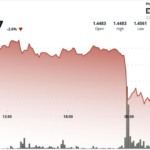
As share prices of top-tier companies experience a downturn, savvy investors often jump at the chance to investigate the circumstances, viewing potential dips as opportune moments to purchase undervalued stocks. Currently, one prominent industry leader has captured attention due to its significant historical performance juxtaposed with a recent price decline.
Over the past five years, shares of O’Reilly Automotive have surged by an impressive 174%, far outpacing the S&P 500’s total return of 82%. However, this achievement has been tempered by a sharp downturn of 19% in the last seven months, leaving investors pondering whether this represents a prime buying opportunity.
O’Reilly Automotive, which operates 6,447 stores across the U.S., specializes in aftermarket auto parts catering to both do-it-yourself customers and professional service providers. This positions the company uniquely, as its products are essential regardless of economic fluctuations. In fact, O’Reilly’s performance remains robust, as evidenced by a same-store sales increase of 4.7% in 2025, marking the 33rd consecutive year of positive sales growth.
The company’s revenue and net income have experienced compound annual growth rates of 8.3% and 10.8%, respectively, over the past decade. O’Reilly continues to expand, having opened 207 new locations last year, with plans to launch an additional 225 to 235 stores in 2026. Moreover, the company adopts a disciplined capital allocation strategy, having invested approximately $7.4 billion into stock buybacks over the last three years—equivalent to about 10% of its current market capitalization. This practice enhances shareholder value by boosting earnings per share.
Currently, O’Reilly’s stock price has settled at $87.29 after a slight 0.70% decline. Key metrics reveal a market capitalization of $73 billion, with a price-to-earnings (P/E) ratio that, despite a recent drop, still hovers at 29.5. This represents a decline from its peak of 38.6 in September when the stock hit an all-time high, but it remains above the average of 26.6 over the past five years.
While some investors might find the current P/E ratio somewhat attractive given the recent price drop, others remain cautious. A valuation above 25 might not provide the compelling case needed to justify an investment in this retail stock at present. While O’Reilly has shown resilience and a capacity for growth, opinions on its valuation indicate that it may still be on the high side for those looking for a value investment.
Ultimately, the recent stock dip could entice certain investors to seize the opportunity to acquire shares in a well-established business that boasts a proven track record of success, even amidst market fluctuations.