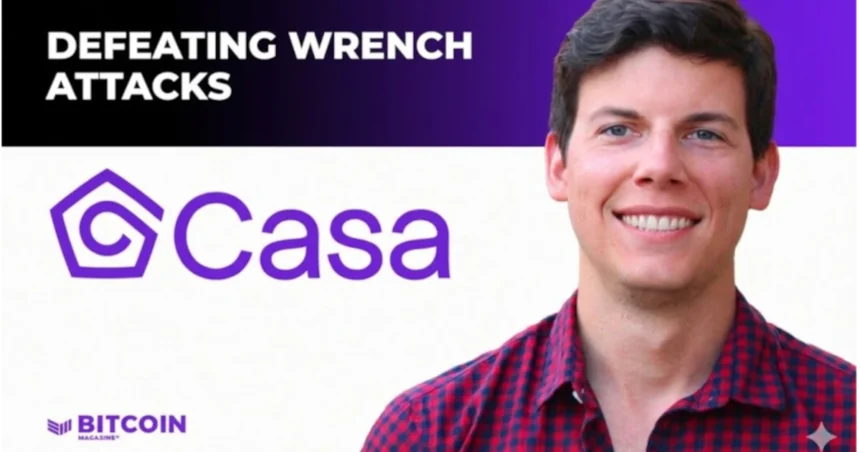
As Bitcoin enters 2026, following a period of robust institutional adoption and relative price stability after the 2024-2025 bull run, self-custody remains central to the cryptocurrency’s promise of sovereignty. However, the landscape surrounding Bitcoin has undergone significant transformation. The introduction of spot Bitcoin exchange-traded funds (ETFs) has made passive investing in Bitcoin more accessible to those accustomed to the trust models of traditional finance. Meanwhile, there has been a notable surge in physical attacks targeting cryptocurrency holders, with incidents known as “wrench attacks” reaching alarming levels.
In an interview with Bitcoin Magazine, Nick Neuman, CEO of Casa, articulated the complexities of self-custody in this evolved market. He positioned Casa’s multisignature (multisig) solutions as a crucial link between the ideal of complete self-sovereignty and the practical needs of high-value Bitcoin owners, particularly in light of modern security threats and geopolitical uncertainties.
Founded in 2018, Casa primarily caters to users with significant Bitcoin holdings—typically five figures or more—whose priorities lean toward financial autonomy rather than convenience. Neuman emphasized Casa’s goal of “maximizing sovereignty and security” through Bitcoin and cryptographic methods, coining the company’s mission as creating “the Swiss bank for the sovereign individual.” This aim reflects a broader view of money as integral to personal freedom.
Despite the promising developments in self-custody, Neuman acknowledged that the complexities involved in managing one’s own Bitcoin can deter users. He noted that Bitcoin self-custody requires a high level of personal responsibility and technical competence, traits not universally found in the average investor. The trend toward convenience—exemplified by the appeal of ETFs—seems at odds with the rigorous demands of self-custody, which generally attracts individuals looking for autonomy and who prefer to steer clear of the risks associated with centralized custodians.
Institutional investors are increasingly recognizing the limitations and risks tied to outsourced Bitcoin custody. Neuman shared that Casa has been assisting large entities, including family offices and corporations, in achieving secure, verifiable control over their Bitcoin. The Office of the Comptroller of the Currency (OCC) recently affirmed that banks can custody crypto assets, provided they comply with regulations, further encouraging institutional players to reassess their custody strategies away from outsourcing.
In response to the decreasing confidence in prevailing custodial practices, Casas’s multisig solutions address concerns about security and control. By necessitating multiple keys for transaction authorization, Casa enables users to rotate keys easily and enhances auditability—key features particularly valuable to institutional clients.
However, despite the focus on sophisticated custodial solutions, the rise of wrench attacks presents a unique challenge. Both Casa and other industry experts have documented considerable increases in these coercive incidents, with some including deadly outcomes. Countries like France and the United States are seeing particularly high rates of such attacks, often linked to taxation disclosures that expose users.
Neuman refuted the idea that relinquishing custody to third parties serves as a viable solution to this growing threat. He recounted a case where a Casa client was coerced into revealing their crypto holdings but managed to safeguard their assets thanks to the multisig setup—illustrating the potential inadequacies of centralized platforms like Coinbase.
In the face of these challenges, Casa’s model promotes strategies such as key dispersion, which mitigates the risks associated with physical coercion. Their system includes an emergency lockdown feature and the option for users to require additional authentication for transactions. By ensuring that keys are not easily accessible, Casa safeguards its users from financial loss in coercive situations.
Adding another layer of complexity, the brokerage model of ETF custody presents its own set of risks, including potential rehypothecation issues and assumptions of false liquidity. Neuman cautioned that ETF investors could still be targets for criminals, and emphasized that, even in an ETF structure, individuals remain vulnerable to political persecution.
In response to emerging needs, new insurance products for self-custody holders are entering the market, providing coverage in specific scenarios, such as kidnapping. While the innovation is promising, Neuman pointed out inherent limitations and highlighted that many potential insurance options are not affordable for average users, leaving a significant gap.
Recognizing the unique demands of their clients, Casa has developed a specialized advisory team to guide new users through the complexities of Bitcoin self-custody. This approach aims to humanize the experience and instill confidence in users navigating the often intimidating world of cryptocurrency.
Furthermore, Casa’s commitment to transparency has driven them to selectively open-source certain components of their technology, enhancing user trust while ensuring the integrity of their services.
In conclusion, while challenges to self-custody appear significant, the principle of personal sovereignty continues to adapt. The evolution of technologies, insurance options, and client advisory services demonstrates that the vision for a decentralized, user-controlled financial future remains alive, forging ahead by addressing the threats and needs of today’s Bitcoin holders.