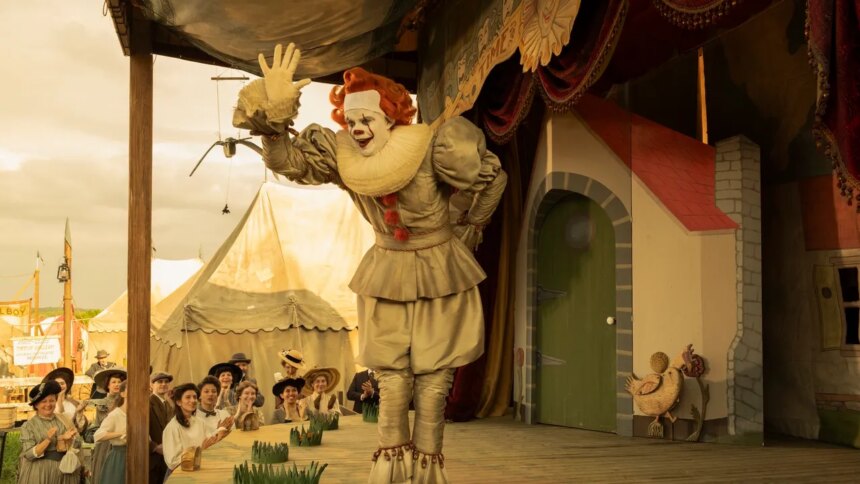
In the latest episode of HBO’s It: Welcome to Derry, titled “The Black Spot,” the series boldly ventures into the chilling depths of Stephen King’s lore, delivering a dramatic adaptation of one of the novel’s most haunting historical interludes. This penultimate episode not only explores the harrowing past of the iconic Pennywise but also presents a compelling portrayal of Bob Gray, the man behind the mask, played by Bill Skarsgård.
The show’s inception nearly four years ago marked the beginning of a collaboration between acclaimed director Andy Muschietti, producer Barbara Muschietti, and writer Jason Fuchs. This venture into the Pennywise universe unfolded after the success of the earlier It films, which collectively grossed around $1.2 billion. As co-showrunner alongside Brad Caleb Kane, Fuchs recently discussed the creative journey behind bringing Bob Gray to life, particularly amid the show’s heavy reliance on horror and the narrative’s legacy.
Fuchs reflected on the challenge of innovating within a well-explored narrative to maintain viewer engagement while remaining true to its roots. He acknowledged the delicate balance of incorporating new gore elements and horror tropes to craft a visceral experience for the audience. Drawing from the expansive source material, which spans over 1,100 pages, Fuchs embraced the mystery surrounding Bob Gray—whose existence as a mere alias for Pennywise raises questions about human identity and monstrosity.
In the episode set in 1908, viewers are introduced to Bob Gray as he performs at a carnival, illuminating the duality of the character as both a performer and a figure of terror. Fuchs expressed the weight of responsibility in addressing such a pivotal mystery within King’s work, emphasizing the necessity of delivering powerful answers to fans long intrigued by Pennywise’s origins.
The path to secure Bill Skarsgård’s involvement in the project was fraught with uncertainty, as Fuchs articulated the challenges of developing a story that required the presence of a character and actor synonymous with fear. The pressure was palpable, with script development occurring before any agreement was reached with Skarsgård. However, it was the introduction of Bob Gray that intrigued him, allowing Skarsgård the opportunity to explore the character’s depth in a fresh and compelling way.
Fuchs praised the collaboration between Skarsgård and Muschietti, highlighting their unique relationship which enhances the performances. Skarsgård’s ability to shift between the playful, charismatic Bob Gray and the terrifying Pennywise is noted as a testament to his remarkable talent. The episode encapsulates a moment where children are entranced by Gray’s clown act, demonstrating the darker undercurrents of allure and manipulation that the character embodies.
The creators have hinted at a grander narrative architecture for future seasons, revealing that the series will traverse different time periods—1962 for the first season, 1935 for the second, and an eventual third season set in 1908. This innovative chronological structure aims to fill in the gaps of It’s complex history while uncovering layers of story that have yet to be explored.
Finally, as discussions surrounding the past relationships among characters unfold, Fuchs confirmed that the bond between Ingrid Kersh and Hank Grogan is genuine, arising from shared struggles and a need for refuge from their respective realities. This nuanced understanding adds depth to the character arcs, hinting at a larger narrative tapestry that connects the horrors and humanity within the world of Derry.
As fans eagerly anticipate the season finale, the revelations presented throughout “The Black Spot” have set the stage for a captivating conclusion that promises to intertwine the fates of its characters with the ever-present shadow of It.