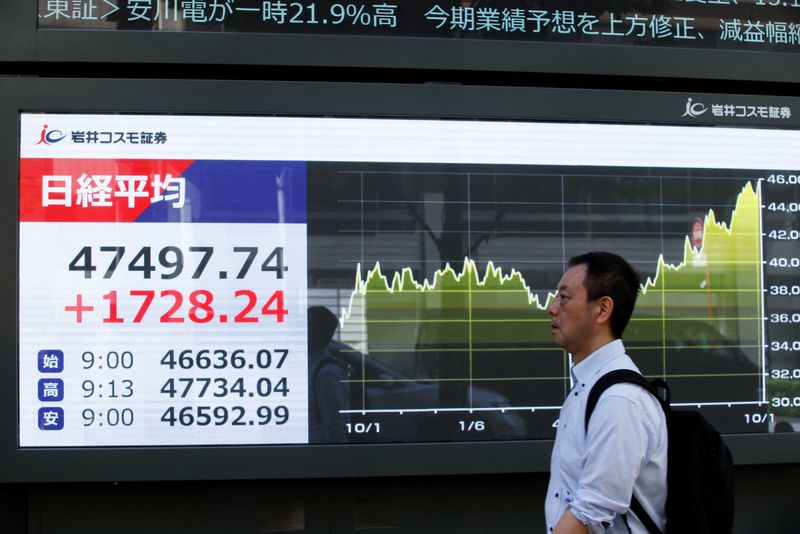
Japanese stocks experienced a remarkable surge on Monday, climbing over 4% to reach an unprecedented all-time high. This bullish trend followed the election of fiscal and monetary dove Sanae Takaichi as the leader of the ruling Liberal Democratic Party, positioning her to potentially become Japan’s first female prime minister.
In early trading, the Nikkei index soared as much as 4.3%, hitting a record 47,734.04 points within the first quarter-hour. This rally was fueled by heightened investor expectations for fiscal stimulus following Takaichi’s victory over the more moderate Shinjiro Koizumi in the party’s leadership vote on Saturday. Conversely, the yen depreciated sharply, falling 1.6% to almost 150 against the U.S. dollar, while yields on short-dated Japanese government bonds dipped to a two-week low, indicating a decrease in expectations for an imminent interest rate hike by the Bank of Japan (BOJ).
Market sentiment surrounding the possibility of a BOJ rate increase by the end of the year softened significantly, with odds declining from 68% to just 41% following Takaichi’s election. Notably, she had previously criticized the BOJ’s decision to raise rates as “stupid,” but her recent stance has tempered, suggesting that central bank policy should align more closely with government objectives.
Economic analysts from Morgan Stanley MUFG Securities addressed investor concerns regarding potential drastic fiscal measures or political pressure on the BOJ. They emphasized that Takaichi’s views seem to align closely with those of BOJ Governor Kazuo Ueda, who has adopted a cautious approach to policy normalization.
Meanwhile, trading activity across much of the Asia-Pacific region was muted, with major markets such as mainland China, South Korea, and Taiwan closed for holidays. Hong Kong’s Hang Seng index saw a slight decline of 0.3%, while Australia’s benchmark index slipped by 0.1% amid trading interruptions due to various state holidays.
Futures for the U.S. S&P 500 indicated a 0.2% upward movement following a record high reached by the cash index last Friday. The U.S. dollar made modest gains against European currencies, recovering some losses it had incurred in the previous week. The euro decreased by 0.25% to $1.1714, while the British pound fell by 0.23% to $1.34385.
In commodity markets, gold prices surged to new heights, recently trading at around $3,904 after eclipsing $3,919.59 earlier in the day. Bitcoin also reached impressive milestones, with trading around $123,590 after peaking at $125,653.32 on Sunday. Analysts have noted that the ongoing U.S. government shutdown has intensified focus on alternative assets, with Geoffrey Kendrick from Standard Chartered Bank predicting Bitcoin could rise to $135,000 during the shutdown period.
In oil markets, prices increased following a decision by OPEC+ to ramp up production by 137,000 barrels per day from November, mirroring October’s modest output increase amid concerns of a looming oversupply. Brent crude futures climbed by 1.3% to $65.39 per barrel, while U.S. West Texas Intermediate crude rose 1.4% to $61.71.