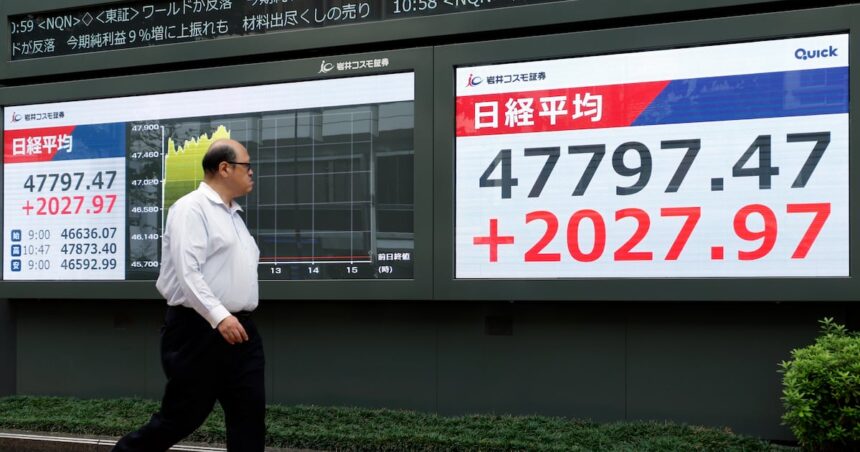
Oil and gold prices experienced a notable increase, while Bitcoin remained close to its recent peak on Monday. The uptick in prices came alongside a sharp rally in Japanese equities, which bolstered overall Asian stock markets. Investors were encouraged by the possibility of a more accommodative monetary policy in Japan following the election of Sanae Takaichi as the country’s first female prime minister. The Nikkei 225 Index surged over 4.78% by 9:20 AM UAE time, crossing the important threshold of 47,000 for the first time.
The market witnessed a weakening of the Japanese yen, which fell by 1.6% to 150 against the US dollar and hit a record low against the euro, according to Bloomberg data. The decline in the yen was attributed to the market’s scrutiny of Takaichi, who is recognized for her pro-stimulus approach. The 30-year Japanese government bond saw a sharp drop, pushing yields near record highs. In contrast, the yield on the two-year note declined, indicating expectations of delayed interest rate increases from the Bank of Japan.
Market analysts remain cautiously optimistic about Takaichi’s plans for increased government spending and monetary easing. Ipek Ozkardeskaya, a senior analyst at Swissquote Bank, commented on the initial market enthusiasm following Takaichi’s ascension, noting her preference for easy fiscal and monetary policies. However, Hitoshi Asaoka, the chief strategist at Asset Management One, warned that while there is welcome support for her spending agenda, achieving these objectives may prove challenging given the Liberal Democratic Party’s minority status.
Asian markets displayed positive momentum overall, with China’s benchmark Shanghai Composite Index rising by 0.52% and India’s BSE Sensex Index increasing by 0.32%.
Meanwhile, the ongoing US government shutdown continued to generate unrest, as labor unions sought legal intervention against mass layoffs initiated by the Trump Administration. The Bureau of Labor Statistics failed to release payroll data on the previous Friday, a critical metric for the Federal Reserve’s interest rate deliberations. The political stalemate poses a significant risk to the timely release of essential economic indicators, with a 60% to 80% probability of further delays, according to Ozkardeskaya.
Despite these challenges, the broader impact on US markets thus far has been manageable. The S&P 500 recorded a flat closure on Friday, having reached multiple record highs in prior weeks. The Dow Jones Industrial Average rose by 0.5%, while the Nasdaq Composite index saw a slight decline of 0.28%.
On the commodities side, crude oil prices saw a rise following a modest increase in production announced by the OPEC+ group, which lessened concerns over supply surges. Brent crude, which serves as a benchmark for global oil prices, improved by 1.33%, reaching $65.39 per barrel, while West Texas Intermediate (WTI) rose by 1.40% to $61.73. The slight production increase of 137,000 barrels per day for November is in line with the previous month’s adjustments and reflects confidence in the steady global economic outlook and market fundamentals.
Gold prices surged, hitting near-record levels as investor demand for safe-haven assets increased amidst the ongoing chaos in the US government. Gold rose by 1.19% to $3,931.84 per ounce, reflecting nearly a 50% surge in value this year driven by geopolitical and economic uncertainties and increased central bank purchases.
Bitcoin also saw notable activity, hovering around $123,701.58, close to its all-time high of $125,689 reached over the weekend, according to data from Binance. This resilience in Bitcoin’s value underscores the growing interest and confidence in cryptocurrency despite fluctuating market conditions.