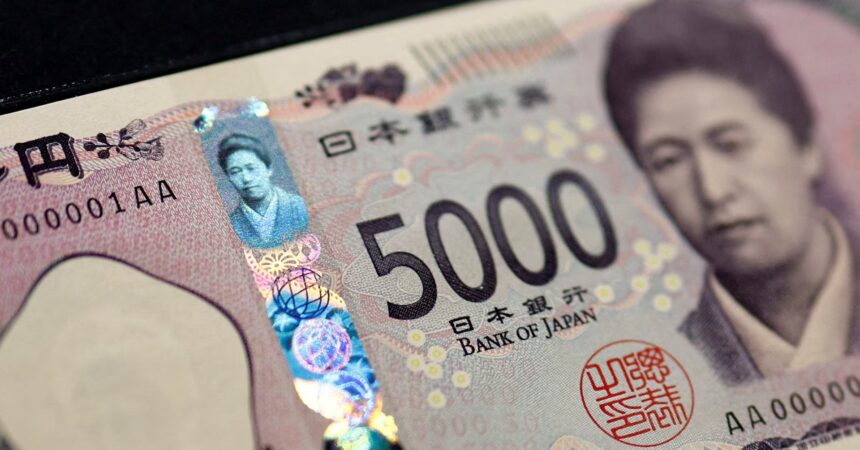
In a significant financial transition, Japan has officially introduced new banknotes in denominations of 10,000 yen, 5,000 yen, and 1,000 yen, showcasing advanced holographic technology that alters images and colors based on the viewer’s angle. The unveiling took place at the Bank of Japan’s currency museum in Tokyo on July 3, 2024. The new 5,000 yen banknote, in particular, drew attention for its innovative holograms, marking a notable change in the currency’s design.
In a contrasting economic landscape, the yen has been struggling, recently dropping to nine-month lows amid shifting market sentiments. Investors had anticipated a resurgence of the yen coinciding with expectations for a slowdown in the U.S. economy, prompting record wagers on its appreciation. Instead, the currency’s performance has reflected the realities of a resilient U.S. economy, where expectations for sustained interest rate cuts have diminished.
The yen’s downturn has been attributed to a combination of factors. Speculators have reassessed their positions as the new Japanese government, under Prime Minister Sanae Takaichi, has adopted a conservative approach toward interest rate hikes. The Bank of Japan (BOJ) has maintained cautious monetary policy, concerned about the potential negative impacts of rate increases amidst Japan’s prolonged battle with deflation.
Market analysts have noted that, after peaking in April, the yen’s value has fallen, driven by expectations of increased economic stimulus in Japan. This has left many investors recalibrating their bets, shifting from bullish to neutral positions on the currency over the past several months. Bart Wakabayashi, branch manager at State Street in Tokyo, indicated that the anticipated convergence of interest rates between the U.S. and Japan is failing to materialize as expected.
On a broader scale, the economic scenario has prompted discussions around possible government intervention as the yen hit a recent low of 155.05 against the dollar. Analysts suggest a continued preference for a weaker yen, reflecting the market’s lack of confidence in a swift recovery.
Moreover, Takaichi’s administration has emphasized low interest rates in conjunction with augmented government spending as part of a strategy to foster growth, further complicating the outlook for the yen. James Athey from Marlborough in London expressed concern that the current economic direction may be disadvantageous for the currency.
Japan’s long-standing struggle with deflation has led to historically low interest rates, with only modest increases observed this year. The BOJ’s recent move saw the policy rate rise to 0.5% — a cautious increase aimed at maintaining economic stability while preventing any stifling of growth momentum.
As markets adapt, notable changes in speculative positions are unfolding. Although the exact positioning data remains uncertain due to the ongoing U.S. government shutdown, earlier reports indicated a significant reduction in long yen positions since reaching record highs in April.
Despite some rising optimism regarding potential adjustments in Japanese interest rates, the forecast for dollar/yen exchange rates remains cautiously pessimistic, with expectations suggesting potential further declines of the yen. Strategists advise investors to focus on carry trade strategies, which typically involve selling yen to exploit interest rate disparities.
In summary, Japan’s introduction of new banknotes coincides with a challenging environment for the yen, characterized by diminishing speculative bets on its appreciation and persistent pressures from domestic and international economic dynamics. The outlook remains clouded, and analysts continue to reassess adaptive strategies in an unpredictable financial climate.