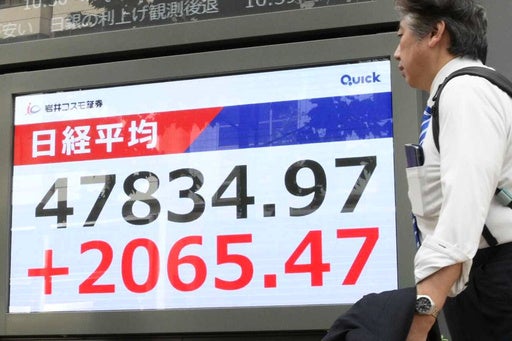
Japan’s Nikkei stock index surged nearly 5% on Monday, marking a significant uptick after the ruling Liberal Democratic Party (LDP) elected Sanae Takaichi as its new leader. This decision positions Takaichi to potentially become Japan’s first female prime minister, carrying on the legacy of the late Prime Minister Shinzo Abe, an influential figure known for his market-friendly economic policies.
Takaichi, 64, an ardent supporter of Abe’s ultra-conservative vision, is expected to steer Japan’s economy through numerous challenges, including enhancing its competitiveness and addressing the issues associated with an ageing and declining population amid a significant public debt burden. Her leadership has sparked investor optimism, particularly among foreign investors, who seem to favor her proposed approach.
Investor reactions were notably positive, as defense stocks saw dramatic increases, reflective of Takaichi’s hawkish military stance. This led to notable rises in shares of Kawasaki Heavy Industries by 9.2% and Mitsubishi Heavy Industries by 11.1%. Additionally, the auto industry also benefited from speculation that U.S. President Donald Trump might consider lowering tariffs on auto parts, propelling Toyota Motor Corp. shares up 4.9% and Honda Motor Co. shares up 4.1%.
As the Nikkei 225 index climbed 4.8% to 47,944.76, the currency market reacted as well, with the yen weakening against the U.S. dollar, indicative of expectations that Takaichi’s policies may boost spending and subsequently create inflationary conditions. The dollar climbed to 150.14 yen from 149.33 yen, while the euro also saw a dip to $1.1704.
Meanwhile, other Asian markets displayed mixed results, with Hong Kong’s Hang Seng index dropping 0.6% and the Australian S&P/ASX 200 index edging down 0.1%. Markets in mainland China, Taiwan, and South Korea remained closed for holidays.
Stateside, U.S. futures showed a positive trend, supported by the recent upward momentum in stock values. On Friday, the S&P 500 and Dow Jones Industrial Average achieved record highs, although the Nasdaq composite experienced a slight drop. The ongoing U.S. government shutdown, which started on October 8, has delayed crucial employment data, which investors are closely monitoring, particularly as expectations mount regarding the Federal Reserve’s potential interest rate adjustments.
In the commodities market, U.S. benchmark crude oil gained $0.99 to reach $61.87 per barrel, while Brent crude rose $0.99 to $65.52 per barrel. The OPEC+ alliance announced a modest increase in oil production, indicating a gradual approach in response to a stable global economic outlook, providing relief from oversupply fears. This decision will see an increase of 137,000 barrels per day for November, maintaining the same output level established in previous months.
Overall, the developments in Japan’s political landscape are reverberating throughout global markets, demonstrating a complex interplay of domestic politics and international economic conditions.