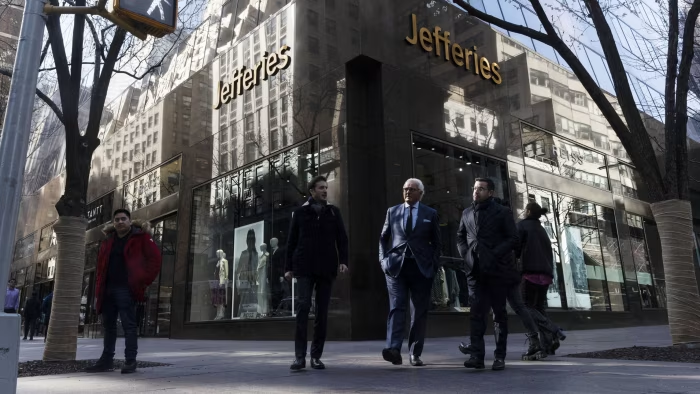
Jefferies Financial Group is facing significant turmoil following the bankruptcy of First Brands Group, with CEO Rich Handler informing investors that the bank believes it was “defrauded” by the company. This alarming revelation comes as Wall Street grapples with the broader implications of the auto parts group’s collapse, causing investors to react by selling off shares in US regional banks over concerns regarding credit quality.
The KBW regional bank index suffered a 6 percent drop on Thursday, though it managed to recover somewhat by Friday afternoon. The bankruptcies of First Brands and car finance company Tricolor, along with disclosures of alleged fraudulent activities by borrowers at Western Alliance and Zions Bank, have cast doubt on the integrity of lending standards during what many considered a credit boom. As a result, the Vix index, which is a key measure of market volatility, reached its highest point since April before settling down.
During an investor day event on Thursday, Handler candidly addressed the serious situation surrounding First Brands, stating, “we believe we were defrauded.” His comments were formally documented in a regulatory filing the following day. The bank’s shares have suffered a staggering decline of more than 25 percent over the past month, largely due to concerns about its financial ties to First Brands, where Jefferies had originally facilitated the raising of billions in debt from investors.
Investors are voicing criticism regarding Jefferies’ Point Bonita fund, which has around $715 million tied up in First Brands. An investor described this as a “risk management 101 failure,” highlighting that the exposure to First Brands is far from isolated given that Jefferies had also previously faced repercussions from investments in schemes later identified as fraudulent.
Brian Friedman, Jefferies’ president, sought to minimize concerns by indicating that Point Bonita’s exposures were primarily linked to investment-grade-rated clients, a factor he considered a “meaningful risk mitigant.” While Jefferies maintains that its overall balance sheet is less affected, Handler noted that the situation had not significantly harmed the bank’s core operations. He went on to emphasize the bank’s strong quarterly performance despite recent challenges.
Looking ahead, Handler mentioned the forthcoming “knockdown process” in bankruptcy court that may shed light on the events leading to First Brands’ financial difficulties. Jefferies’ leveraged finance division has also come under fire for its involvement in funding First Brands through multiple transactions, including a postponed $6 billion deal amid growing scrutiny of the company’s finances. Handler clarified that Jefferies was more often advising First Brands’ acquisition targets rather than the company itself.
While Jefferies struggles to manage its exposure and restore investor confidence, US regional banks have sought to reassure market participants about credit quality in their recent earnings reports. Truist Bank CEO Bill Rogers characterized recent loan losses as “idiosyncratic and uncorrelated,” emphasizing an overall strong credit position for the bank.
The unfolding scenario has ignited a debate among financial institutions, with Handler noting a “fight going on” between banks and private credit firms, as each attempts to deflect blame onto the other for supporting troubled businesses, including First Brands. Jefferies has refrained from further comments, and requests for insight from First Brands and its founder, Patrick James, have gone unanswered, although James’ spokesperson affirmed that he had not been accused of any wrongdoing and expressed confidence in an independent investigation stemming from the bankruptcy proceedings.