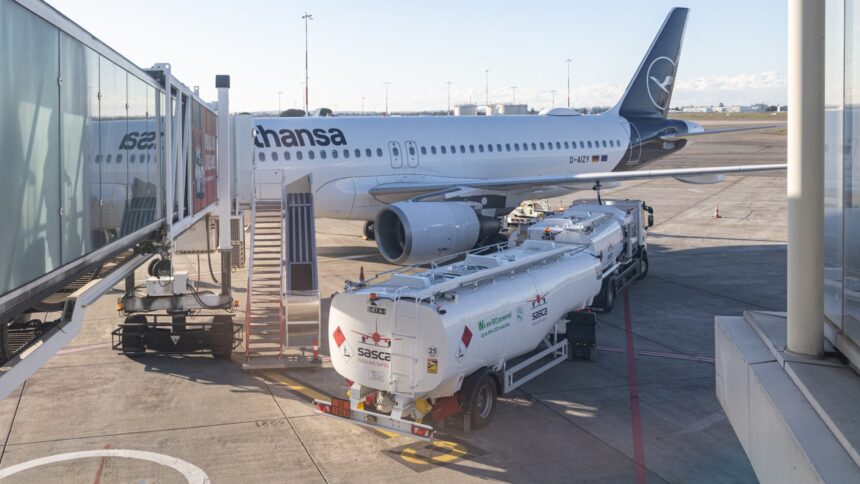
A Lufthansa passenger aircraft was spotted at a gate while a SASCA fuel truck serviced it at Toulouse Blagnac Airport in France on March 15, 2026. The aviation industry is grappling with a surge in jet fuel prices, which have approached crisis levels due to geopolitical tensions. Following military actions by the U.S. and Israel against Iran on February 28, 2026, the price of jet fuel in the U.S. has nearly doubled—rising from $2.50 a gallon on February 27 to $4.88 by April 2. This price hike is being exacerbated by the effective closure of the Strait of Hormuz, significantly impacting the supply of both crude oil and refined products like jet fuel.
Airlines are now confronted with the dilemma of whether they will have enough fuel to meet operational needs, and some carriers are already contemplating cutting flights, particularly on international routes. Carsten Spohr, CEO of Deutsche Lufthansa, addressed employees in a recent webcast, informing them that the airline is forming teams to devise contingency plans in response to the ongoing conflict in the Middle East. These strategies may include grounding some aircraft if demand drops or fuel shortages occur.
While the U.S. boasts substantial jet fuel production and is less vulnerable than regions like Europe and parts of Asia, U.S. airlines are also feeling the pinch. United Airlines CEO Scott Kirby mentioned the likelihood of reducing flights to Asia given that his airline has the most service to that region. He emphasized the vulnerability of certain parts of the U.S. to fuel shortages, particularly areas that lack strong pipeline connections. Kirby warned that fuel prices could remain elevated, predicting oil to stay above $100 per barrel through 2027.
Airline capacity adjustments are underway, with expectations of more cuts in the coming weeks. Domestic capacity for U.S. carriers is projected to grow by 2.1% in the second quarter, slightly lower than previous estimates. Total capacity is also set to increase, but at a diminished rate of 1.1%. These changes reflect a cautious approach from carriers facing increased operational costs due to fuel price surges.
Despite the challenges posed by rising jet fuel costs, airline executives continue to report strong travel demand as the peak summer season approaches. However, with fuel representing airlines’ second-largest expense after labor, they are already implementing fare increases and additional fees—such as for checked luggage—to offset escalating costs. Following the escalation in the U.S.-Israeli conflict, airlines in other regions, such as Indonesia, have also responded by introducing jet fuel surcharges.
Investors are keenly watching how these developments could impact airline profitability as the earnings season begins. Delta Air Lines, which owns its own refinery, may find itself in a favorable position amid soaring fuel costs. Recently, Delta increased checked bag fees, following the lead of JetBlue Airways and United.
While demand remains robust compared to last year—when economic uncertainties from trade tensions affected bookings—the higher fuel prices present a significant hurdle for airlines. Analyst Savanthi Syth from Raymond James indicated that if fuel prices persist at their current levels, airlines may be compelled to reduce capacity further.
The overall economic climate adds another layer of complexity, as elevated gasoline prices coupled with other pressures may lead to reductions in consumer spending. Joseph Rohlena from Fitch Ratings is closely monitoring the situation, noting that sustained high fuel prices could put downward pressure on airline valuations.
As the airline industry navigates this turbulent landscape, it remains to be seen how escalating fuel costs will shape operational strategies and financial performance in the months ahead.