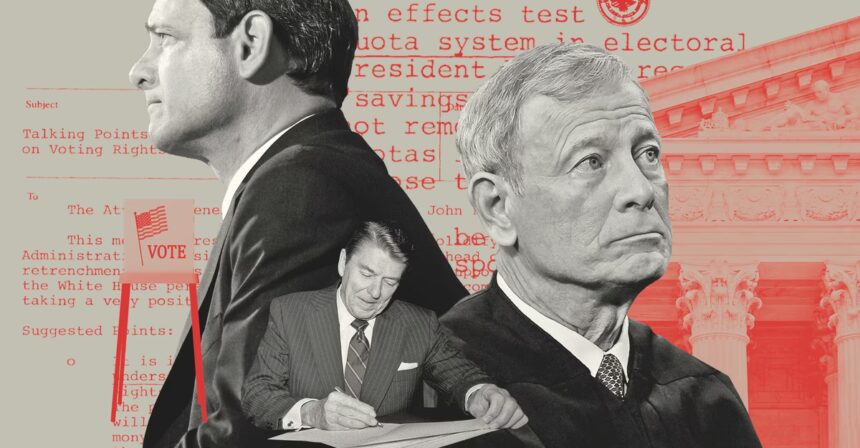
In a significant legal context, the history of the Voting Rights Act (VRA) and its future viability are under scrutiny as the U.S. Supreme Court prepares to adjudicate Louisiana v. Callais. This case raises crucial questions about the interpretation of Section 2 of the VRA, particularly regarding whether racial discrimination in election laws should be identified by intent or effect. During recent oral arguments, it became evident that a majority of the conservative justices are inclined to restrict the role of race-based data in redistricting, a move that could substantially weaken protections for minority voters.
This legal battle brings the spotlight back to John Roberts, the current Chief Justice, who played a pivotal role during the 1982 reauthorization of the VRA while serving under the Reagan administration. At that time, Roberts’s objectives mirrored those suggested by the Reagan Justice Department: to support the VRA nominally but effectively render it unserviceable. The outcome of the Callais case could echo the ideological struggles of Roberts’s early career, involving concerns over racial discrimination and election laws that he navigated closely.
Roberts’s work at the Department of Justice during the early 1980s placed him in a critical position as the government grappled with the implications of a Supreme Court ruling that necessitated proof of racial intent for claims under Section 2. This ruling effectively stymied much of the litigation designed to protect minority voting rights. Civil rights advocates, along with moderates from both parties, sought to clarify that the intent versus effects standard needed to evolve to better serve the original purpose of the VRA.
As Roberts found himself in the thick of the political fray, he meticulously crafted messaging strategies meant to secure the administration’s position while softening the VRA’s impact. His internal documents from the National Archives reveal a dedicated approach to promoting the intent standard, which would ultimately hinder the efficacy of the VRA’s protections. Despite initial resistance from moderate elements within the administration, Roberts succeeded in pushing back against reforms that would bolster minority voting rights and embraced a position that critics argue led to the legislative statute becoming less effective.
The debate that took place at the Senate level in 1982 highlighted intense ideological divisions, especially as civil rights figures, like Vernon Jordan, decried the administration’s stance as fundamentally flawed. They argued that the focus on intent would set an unachievable burden for minority groups trying to claim their voting rights were infringed upon. Roberts, however, continued to support the administration’s intent standard and sought to discredit the call for an effects standard as a radical overhaul that would destabilize electoral politics.
In the years that followed, Roberts’s experience laid a foundation for his judicial philosophy and actions once he ascended to the Supreme Court. The ideological battles of the early 1980s inform a contemporary context wherein the mere majority opinion of the Court could effectively overwrite legislative protections once deemed critical. The scenarios unfolding in Louisiana v. Callais suggest the possibility of a judicial rollback not just of the VRA but also of civil rights more broadly, setting a stage for substantial changes in how election laws are constructed and enforced, particularly in regions still grappling with the legacies of racial discrimination.
As the Court prepares to rule, advocates for voting rights remain apprehensive, understanding the potential implications of a decision that could further diminish the protections afforded under the VRA. The continued evolution of this case underscores the critical role of the judiciary in shaping the political landscape and, by extension, the democratic principles upon which the nation was built.