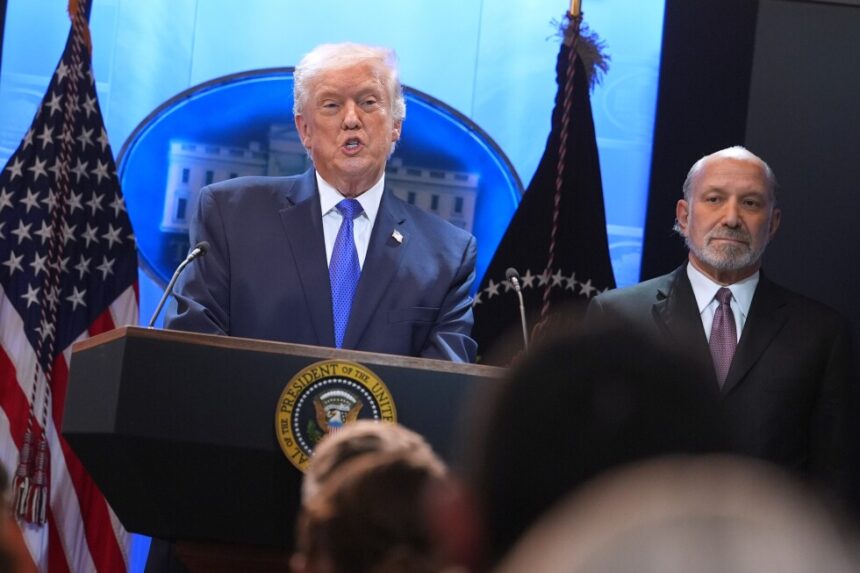
In a significant development within the ongoing legal battle involving President Donald Trump and JPMorgan Chase, the bank has officially acknowledged that it closed the accounts of Trump and multiple businesses linked to him in the wake of the January 6, 2021, Capitol riots. This revelation comes as part of a court filing submitted in response to Trump’s lawsuit seeking $5 billion in damages. Trump’s legal team argues that the account closures were politically motivated, disrupting his business operations.
The acknowledgment was documented in a statement from Dan Wilkening, JPMorgan’s former chief administrative officer, who confirmed that the bank notified Trump in February 2021 that specific accounts within its private and commercial banking arms would be shut down. Up until now, JPMorgan had only addressed the concept of account closures in general terms, never admitting in writing the specific actions taken against Trump.
A spokesperson for JPMorgan declined to extend further commentary beyond what was articulated in the legal filings. The lawsuit, initially filed by Trump in a Florida state court, aims to transfer the case to a federal court in New York, where both the accounts and most of Trump’s business operations were originally based.
Trump contends that the bank engaged in trade libel and breached both state and federal unfair business practices laws. He indicated that after receiving the notices regarding the closure of his accounts, he attempted to discuss the matter directly with Jamie Dimon, JPMorgan’s CEO. However, Trump claims that Dimon failed to follow up as promised.
The lawsuit also claims that JPMorgan placed Trump and his associated businesses on a “reputational blacklist,” which may prevent them from opening accounts with other banks in the future—a claim yet to be fully detailed by Trump’s legal team. In response, JPMorgan’s lawyers stated they would address the matter of the alleged blacklist once further clarification is provided.
While JPMorgan has expressed regret over Trump’s decision to pursue legal action, it maintains that the lawsuit lacks merit. The controversy surrounding the concept of “debanking,” wherein customers find their accounts closed or are denied services by financial institutions, has emerged as a highly politicized issue. Conservative figures, including Trump, argue that banks have disproportionately targeted them and their affiliates based on reputational risks that can lead to discriminatory practices.
The term “debanking” garnered national attention during the Obama administration when accusations arose that banks were pressured to cease services to certain businesses, like gun stores, under a program termed “Operation Choke Point.” Following the Capitol riots, conservative leaders, including Trump, accused financial institutions of severing ties based on reputational risk. In response, regulatory moves have been made to prevent banks from citing such risks as justification for denying services.
Trump’s legal disputes with banks are not limited to JPMorgan; he has also filed lawsuits against other financial institutions. For instance, the Trump Organization’s ongoing case against Capital One, initiated in March 2025, similarly addresses claims of being unfairly debanked.
As this case progresses, it remains entwined with broader discussions surrounding banking practices and the intersection of finance and politics, highlighting a growing concern among some factions that financial institutions wield excessive power over their clients.