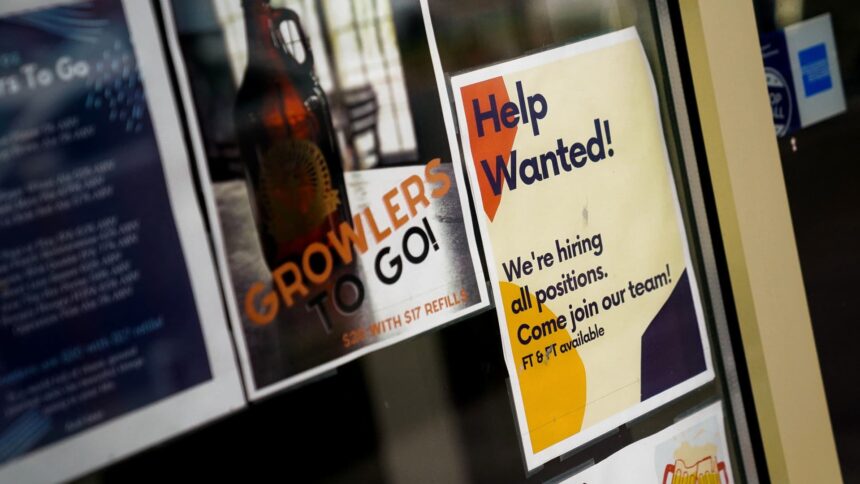
An employee hiring sign was spotted in a window of a business in Arlington, Virginia, as economic indicators are set for scrutiny today with the delayed nonfarm payroll report scheduled for release at 8:30 a.m. ET. Investors and policymakers alike are gearing up for the data, which follows a recent interest rate cut by the Federal Reserve. Economists surveyed by Dow Jones predict that the U.S. added 45,000 jobs in November, with the unemployment rate expected to rise to 4.5%. Federal Reserve Chair Jerome Powell noted last week that there might have been a “systematic overcount” in previous job numbers, suggesting significant revisions could be on the horizon.
Within the context of the job market, uncertainty looms over who will succeed Powell as head of the Federal Reserve. Reports indicate that National Economic Council Director Kevin Hassett’s candidacy is facing opposition from individuals close to President Donald Trump. As investors await the jobs report, equity markets ended the previous day in negative territory, chiefly influenced by declines in artificial intelligence-related stocks amid ongoing financing concerns. Additionally, the upcoming consumer price index for November, also delayed due to the recent government shutdown, will further shape market discussions.
In the automotive sphere, Ford has announced a staggering cost of $19.5 billion due to special items related to its pivot away from all-electric vehicles. This shift comes as Ford aligns itself with consumer preferences by prioritizing hybrid vehicles and opting to scrap a generation of fully electric trucks in favor of more compact and affordable models. CEO Jim Farley emphasized in a recent interview that the decision stems from an analysis of market demands, especially in light of sluggish sales for high-end electric vehicles.
On the trade front, revenue generated from new tariffs imposed by Trump has crossed the $200 billion mark, according to reports from the U.S. Customs and Border Protection agency. While these tariffs have dramatically altered global trade dynamics this year, their future is uncertain as the Supreme Court deliberates over their legality. A ruling against the tariffs could result in refunds for businesses that have already settled their payments. Notably, tariff revenue decreased in November from the previous month for the first time since the imposition of the tariffs.
Consumer sentiment remains subdued, yet this has not deterred holiday shopping. A recent report highlights that the number of Americans who participated in the shopping spree from Thanksgiving to Cyber Monday reached its highest number in nine years. Retail giants like Costco and Best Buy have reported strong starts to the crucial holiday selling season. Nonetheless, the downward economic outlook is prompting many shoppers to focus on budget-conscious retailers such as Walmart and T.J. Maxx, indicating a shift in buying behavior even amid increased spending.
In the tech sector, the landscape of transportation is rapidly transforming with the emergence of robotaxis. Just a decade ago, these driverless vehicles seemed like a distant fantasy, but today they are becoming ubiquitous across various American cities. Waymo, a leader in the autonomous vehicle market, is currently operating, testing, or planning to launch services in 26 global markets. Meanwhile, Amazon’s Zoox and Tesla have begun rolling out their robotaxi services this year, resulting in a spike in Tesla shares. However, challenges remain, such as concerns about noise and congestion, safety issues, and pricing disparities compared to traditional rideshare options.
Overall, the intersection of employment data, market shifts in the automotive industry, trade policy developments, retail dynamics during the holiday season, and advances in autonomous technology paints a complex picture of the current economic landscape.