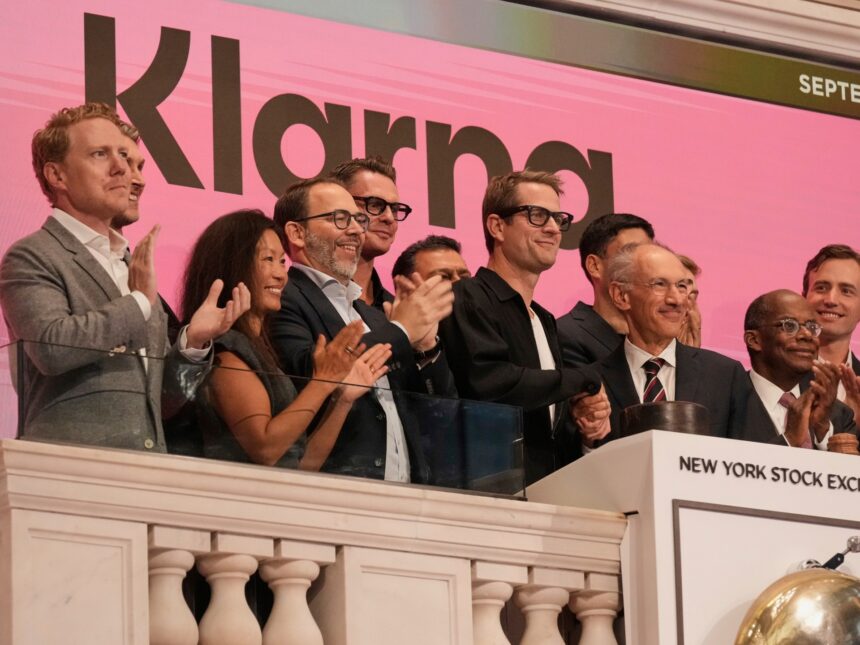
The fintech company Klarna has officially made its debut on the New York Stock Exchange (NYSE), marking a significant moment in the ongoing wave of high-profile initial public offerings in 2023. The Swedish buy-now-pay-later giant sold 34.3 million shares at $40 each on Tuesday, exceeding the predicted range of $35 to $37 per share and giving the company a valuation of over $15 billion. The stock is set to begin trading shortly after its listing on the exchange.
With this IPO, Klarna has raised approximately $1.37 billion, making it the largest IPO this year, according to Renaissance Capital. This accomplishment is noteworthy in a year that has seen a bustling activity in the public market. Other notable IPOs this year include design software company Figma and Circle Internet Group, which is behind the issuance of the USDC stablecoin. In addition, the market eagerly awaits the debuts of the ticketing service StubHub and cryptocurrency exchange Gemini, owned by Cameron and Tyler Winklevoss.
Klarna was founded in 2005 as a payment solutions provider and broke into the U.S. buy-now-pay-later space in 2015 through a partnership with Macy’s. Since then, the company has rapidly grown its reach, collaborating with hundreds of thousands of retailers and integrating into internet browsers and digital wallets as a modern alternative to traditional credit cards. Recently, Klarna announced a partnership with Walmart, further expanding its services.
Trading under the symbol “KLAR,” company executives made the strategic decision to go public in the U.S. to capitalize on the vast opportunities presented by the American consumer market, which is the largest in the world and the leading credit card market. CEO and co-founder Sebastian Siemiatkowski emphasized this perspective in a recent interview, expressing the intention to attract consumers away from traditional credit cards, which he described as a high-interest and often exploitative option.
Klarna’s flagship product is its “pay-in-4” plan, allowing customers to break up purchases into four installments over six weeks. This model has gained traction among consumers hesitant to use credit cards. The company reported that a staggering 111 million users globally have utilized its services. However, concerns have arisen regarding the financial implications of buy-now-pay-later services, particularly the risk of consumers overextending themselves, mirroring trends observed in credit card usage. Siemiatkowski reassured stakeholders, pointing out that the average balance for Klarna users is less than $100 and that the company can adjust its underwriting standards based on economic conditions due to the short-term nature of its loans.
In its second quarter prior to the IPO, Klarna generated $823 million in revenue, with an adjusted profit of $29 million. The company reported a delinquency rate of just 0.89 percent for its pay-in-4 loans and 2.23 percent for its longer-term loans, both figures significantly lower than the average delinquency rates of traditional credit cards.
With this public offering, Klarna has now become the second-largest buy-now-pay-later company by market capitalization, trailing only Affirm. Shares of Affirm have seen a significant increase this year, fueled by investor confidence that these companies could potentially capture significant market share from conventional banks and credit card providers.
JPMorgan Chase and Goldman Sachs served as the primary underwriters for Klarna’s IPO, marking a potential shift in the credit and finance landscape as consumer preferences evolve towards more flexible payment options.