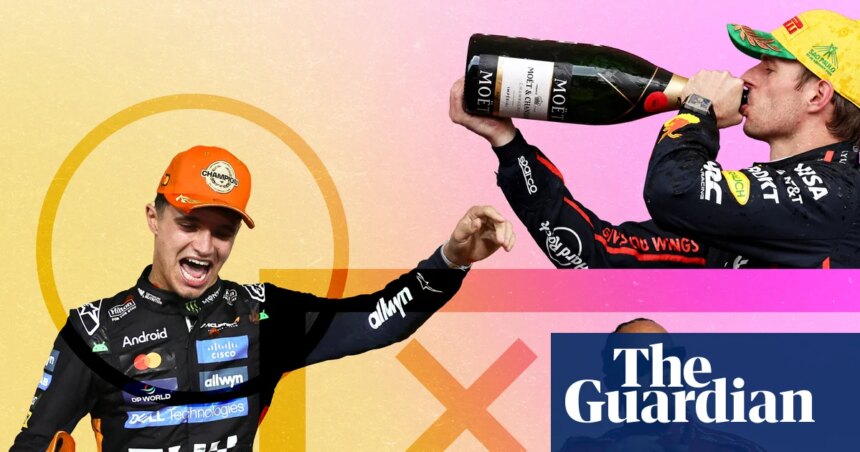
In a season defined by fierce competition and extraordinary individual performances, Lando Norris emerged as the world champion, claiming his first title in what was a nail-biting finale. The McLaren driver began the season as the favorite and ultimately fulfilled those expectations despite facing formidable challenges from his teammate Oscar Piastri and rival Max Verstappen.
Securing the championship was no straightforward task for Norris, who at one point found himself 34 points behind Piastri following a disappointing race at Zandvoort, where a mechanical failure left him despondent on the track. However, displaying remarkable resilience and skill, Norris rebounded with outstanding performances that brought him back into contention. McLaren’s consistent form, aside from a couple of missteps in Las Vegas and Qatar, culminated in a significant achievement as he held his nerve to clinch the title in Abu Dhabi, marking a hard-fought victory.
Piastri had a strong season, showcasing his talent with several impressive wins but ultimately faltered in the final third of the year. His drop in performance during crucial races with low grip led to costly errors and hampered his title aspirations. On the other hand, Verstappen’s charge from a staggering 104 points deficit at the Dutch Grand Prix to just 10 points behind Norris in Abu Dhabi was a testament to his unwavering determination. Although he did not capture the championship, his drive showcased his ability to compete at the highest level.
McLaren’s overall performance marked a historic year, as the team not only secured its first driver’s title since 2008 but also achieved a constructors’ title—its first double since 1998. The team’s decision to allow their drivers to race freely throughout the season, despite some strategic miscalculations, demonstrated a commitment to fairness that garnered both praise and scrutiny. Despite facing challenges, such as double disqualifications in Las Vegas and questionable strategies in Qatar, McLaren’s car was dominant for much of the season. The team solidified their constructors’ championship well in advance, with several races still to go.
The race of the season was arguably Brazil, where Verstappen, starting from 19th place due to issues in qualifying, showcased his prowess with a remarkable recovery drive. After a challenging weekend with his car’s performance, he managed to claw his way up the field to finish third—maintaining his presence in the championship fight.
Verstappen’s overtaking maneuver at Imola also stood out as one of the most commendable moments, where he executed a daring move around the outside of Piastri at the first turn, claiming the lead early in the race. This remarkable display of skill came amidst a difficult phase for Red Bull, further emphasizing Verstappen’s exceptional talent.
On the flip side, Lewis Hamilton’s debut season with Ferrari was marked by high hopes but yielded disappointing results. Despite winning a sprint race in China, his overall performance fell short, leading to a sixth-place finish in the championship and no podiums—an unprecedented situation for the seasoned driver. Hamilton characterized the experience as “a nightmare,” but expressed hope that Ferrari could rebound in the future.
The surprise success of the 2025 season came from Williams, which finished fifth in the championship—a significant leap given their history of struggles. Under the leadership of team principal James Vowles, the team managed to execute impressive races, particularly in Miami, where their drivers, Alex Albon and Carlos Sainz, displayed competitive prowess against established teams.
As the season concludes, the narrative of resilience, strategy, and skill has undoubtedly set the stage for an even more electrifying 2026 season, with teams and drivers looking to build on their successes and rectify their shortcomings.