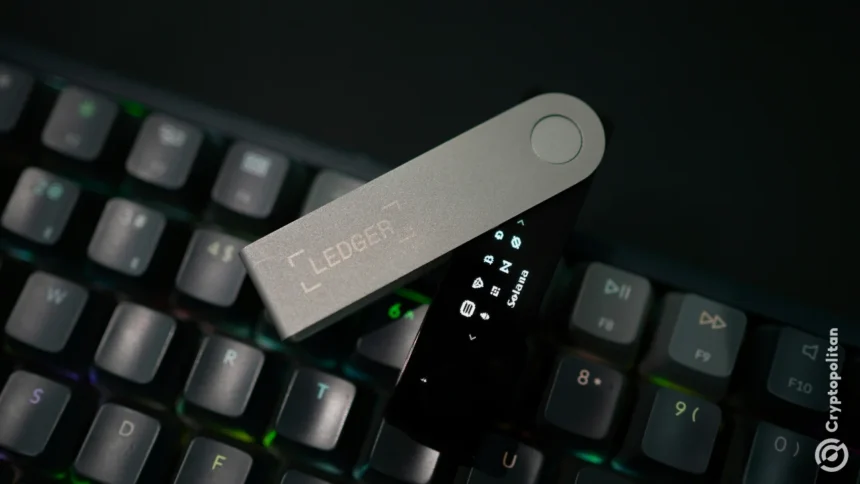
Blockchain hardware manufacturer Ledger has revealed an expansion of its decentralized trading capabilities within its wallet ecosystem, marking a significant advancement in secure access to multichain swaps. In a recent blog post, Ledger announced the integration of OKX DEX, allowing users to perform cross-chain trades directly from their Ledger Wallet while ensuring that their private keys remain stored offline and accessing aggregated liquidity efficiently.
Under this new agreement, customers will gain access to one of the most advanced multichain aggregators globally, facilitating a seamless transition into decentralized finance (DeFi). The integration aims to simplify on-chain trading through the use of OKX DEX, which serves as a powerful cross-chain bridge and multichain aggregator. Though part of the broader OKX ecosystem, it operates as a fully decentralized tool similar to a commerce search engine.
Ledger emphasized that users will sign transactions using a Ledger device when trading tokens on-chain via OKX DEX. This integration preserves the essential hardware-enforced security that Ledger is known for, while also ensuring users retain complete self-custody of their assets.
Ledger aims to eliminate the common friction associated with decentralized trading, which often forces users to switch between platforms and manually bridge assets. The firm stated that trades will be executed directly from the Ledger Wallet, allowing consumers to maintain total control over their assets. The integration facilitates swaps across multiple networks, including Ethereum, Arbitrum, Optimism, Base, Polygon, and BNB Chain. Notably, OKX DEX aggregates liquidity from over 400 sources spanning more than 25 blockchains, optimizing price and execution without relying on intermediaries.
Jean-François Rochet, Ledger’s executive vice president of consumer services, explained the significance of this integration, highlighting that it connects OKX with security-conscious users who prioritize self-custody while enhancing Ledger users’ access to competitive exchange pricing.
For users to initiate a trade, they must first authorize the transaction securely by confirming it on their Ledger hardware wallet. They then navigate to the Swap section within the Ledger Wallet app, select OKX DEX as their provider, and choose the assets they wish to swap. The interface will present the best aggregated rates from various liquidity pools before the final confirmation.
This latest development follows a series of enhancements made to the Ledger Wallet, particularly showcased during Ledger Op3n in 2025, as the company aims to position its software as a secure access layer for swaps, yield strategies, and decentralized applications. Over the past two years, Ledger has significantly increased access to DeFi within its wallet, aligning with recent partnerships to further enhance functionality.
On September 17, 2024, for instance, Exodus Movement collaborated with Ledger to roll out a crypto swap aggregator within the Ledger Live application. This feature allows connections to various third-party APA exchange providers, prioritizing user control and security while differentiating itself from centralized exchanges.
In addition, Ledger announced in April of the previous year its collaboration with Kiln, a DeFi infrastructure platform, enabling stablecoin yields directly from self-custody. Users can earn between 5% and 9.9% on assets like USDC, USDT, USDS, and DAI through lending protocols such as Aave, Compound, Morpho, Sky, and Spark, while retaining complete control of their assets.
Moreover, last month, Ledger introduced a bitcoin yield product in partnership with Lombard and Figment. This latest feature allows users to explore various yield opportunities linked to Bitcoin, further broadening the offerings within Ledger’s wallet ecosystem and demonstrating the company’s commitment to enhancing user experience in the decentralized finance landscape.