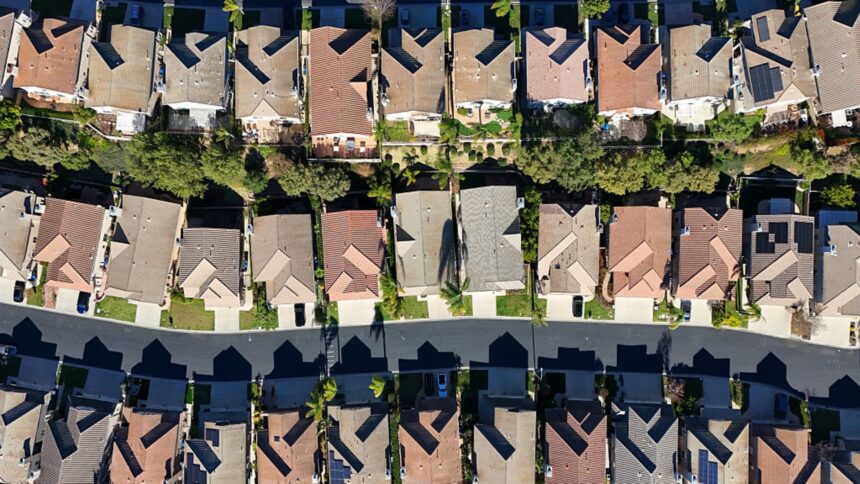
In Thousand Oaks, California, an aerial view reveals the landscape dominated by two-story single-family homes as the nation grapples with a significant shift in the housing market. Legislation aimed at restricting institutional investors from purchasing single-family homes for rental purposes is currently making its way through Congress. However, evidence suggests that many of these investors have already begun selling off substantial portions of their residential holdings over the past two years.
Research from Parcl Labs, a housing data and analytics firm, indicates that some of the largest investment firms are now net sellers. These institutional investors comprise a notable portion of the for-sale listings in major metropolitan markets, often outpacing their share of overall housing stock. Cities such as Dallas, Philadelphia, and Houston have seen particularly aggressive selling, with Dallas investors accounting for 22.8% of new listings while owning just 9.2% of the housing stock.
FirstKey Homes, one of the noteworthy players in this trend, has emerged as a particularly motivated seller, showing over twice the number of listings compared to its peers and slashing prices by an average of 10% from initial asking prices approximately every three weeks. According to Jason Lewris, co-founder of Parcl Labs, the current volatility in the housing market is prompting investors to minimize risk. He explained that with rental prices failing to hold steady, cashing out becomes a more attractive option.
Invitation Homes, regarded as one of the largest publicly traded landlords, has made it a strategic focus to sell existing homes while acquiring new constructions. In its fourth-quarter earnings report for 2025, Invitation Homes confirmed that it sold 315 existing homes while nearly all of its 2,410 acquisitions consisted of newly built homes sourced from various builders.
In a bid to improve housing affordability, President Donald Trump signed an executive order in January aimed at curtailing the influence of large institutional investors in the single-family rental market. The proposed legislation suggests a ban on these investors from acquiring more properties if they already own over 100 homes, though it allows them to retain their current holdings. The current proposal distinguishes between various thresholds for what constitutes a “large” investor, but overall rules are aligned between the Senate and House versions.
It is crucial to note that single-family rentals constitute about 10% of the total U.S. housing stock. Most of these properties—or 80%—are owned by smaller, “mom-and-pop” operators who each manage fewer than 10 homes, while a mere 3% is held by large institutional investors owning more than 1,000 units. However, with the recent shift in market conditions, these numbers have diminished as institutional investors began retreating, selling off homes at heightened rates since late 2024.
The pivot toward building homes rather than buying them illustrates another strategic shift among investors, with many choosing the build-for-rent model. Rick Palacios, director of research at John Burns Research and Consulting, noted that the trend of selling properties has been largely about reallocating capital. Following a surge in home prices after 2020, many single-family rental investors opted to liquidate assets in a favorable pricing environment to reinvest in more lucrative build-to-rent initiatives.
Invitation Homes has been capitalizing on this trend by acquiring partnerships with builders and expanding its portfolio to include properties from ResiBuilt Homes, a builder focused on high-growth markets in the Southeast. Meanwhile, American Homes 4 Rent (AMH) has been investing in the construction of entire rental communities, emphasizing the contribution of over 14,000 newly constructed homes to the national housing inventory since starting its ground-up development program.
As institutional investors shift strategies and navigate the complexities of future legislative measures, the dynamic landscape of the housing market remains a point of interest for both economists and prospective homeowners alike.