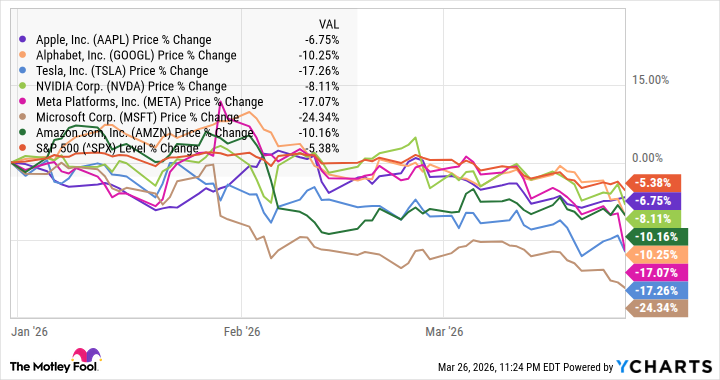
For years, the “Magnificent Seven” tech companies—Apple, Alphabet, Tesla, Nvidia, Meta Platforms, Microsoft, and Amazon—were among the most reliable investments on Wall Street. Following a downturn in 2022, these companies made a substantial recovery, particularly excelling in artificial intelligence (AI). Recently, a report highlighted a lesser-known firm described as an “Indispensable Monopoly,” which provides critical technology that both Nvidia and Intel require, fueling speculation about the potential for AI to create the world’s first trillionaire.
However, after a remarkable three-year surge, the Magnificent Seven now appears to be experiencing a slowdown. Data indicates that all seven stocks have declined this year, underperforming the S&P 500 index. The year 2026 has proven challenging for investors in the tech sector, with particular apprehension surrounding AI disruption causing significant declines in software stocks. Microsoft, in particular, has suffered the most in this group. Many investors are now wary of the massive investments major tech firms are making in AI infrastructure, projecting a nearly $700 billion in capital expenditures collectively from Amazon, Microsoft, Alphabet, and Meta Platforms this year.
This substantial investment is expected to take years before yielding a return, causing skepticism among investors regarding the efficacy of these expenditures.
Interestingly, there are signs of a shift among investors, who may be reallocating their portfolios in anticipation of a broader market rebound. The Invesco S&P SmallCap Information Technology ETF has risen 6%, defying the prevailing trend in the tech sector. In addition, the Russell 2000 index, known for small-cap stocks, has remained flat this year—a performance that exceeds that of the S&P 500—indicating a diversification into smaller companies.
While sentiment towards the Magnificent Seven has soured, many of these firms continue to demonstrate strong financial results. Current valuations for this elite group appear attractive compared to their historical performance. Notably, when excluding Tesla, which shows a price-to-earnings (P/E) ratio over 300, the remaining Magnificent Seven trade at a valuation comparable to the S&P 500’s P/E of 25.6.
Despite recent declines and concerns regarding AI spending, these companies are still leading their sectors and reporting double-digit revenue growth that outpaces the S&P 500. While there are arguments suggesting some of these stocks could be undervalued, Nvidia stands out as particularly noteworthy. Though Nvidia remains one of the pricier stocks in the group, it also boasts the fastest growth rate. Analysts predict an impressive rise in Nvidia’s adjusted earnings per share, projecting it will increase from $4.77 last year to $8.29, resulting in a forward P/E of less than 21.
This valuation signals to investors that the anticipated AI boom may not sustain its momentum, although CEO Jensen Huang forecasts revenue growth could reach $1 trillion over the next two years. Moreover, Nvidia has reported accelerating revenue growth in the last two quarters, countering fears about a decline in its performance following an initial surge in demand.
While it remains to be seen when market sentiment may shift, particularly in light of ongoing geopolitical issues, Nvidia’s current valuation suggests it could yield substantial returns over the long term, even considering potential economic downturns within the AI sector.
Nonetheless, potential investors in Nvidia should be aware that it wasn’t included in a recently published list of the top ten stocks recommended by The Motley Fool Stock Advisor, a service known for its impressive average return of 898%, greatly outpacing the S&P 500’s 182%. This highlights that while Nvidia remains a compelling option, other stocks may also present attractive investment opportunities.