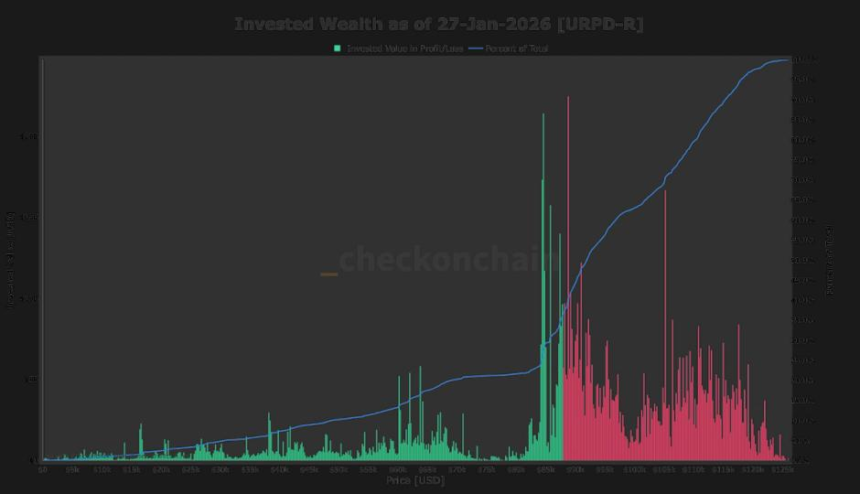
Recent analytics reveal that a significant percentage of Bitcoin investors are feeling the strain of market conditions, with approximately 63% of all investments in Bitcoin—a leading cryptocurrency—trading at a cost basis exceeding $88,000. This estimate comes from data provided by Checkonchain and highlights the challenge many holders face as current market prices hover well below their acquisition costs.
Invested wealth, which measures the total value of capital that has been allocated in Bitcoin based on when the coins last moved on the blockchain, illustrates a concerning trend. The distinction between invested wealth and cost basis is crucial; the cost basis reflects the average price at which Bitcoin was purchased, thereby underscoring that the majority of capital within this asset is positioned underwater—meaning it is less valuable than when it was last acquired.
The UTXO Realized Price Distribution (URPD) metric offers a detailed snapshot of the price levels at which currently available Bitcoin was last transacted. The current trading range for Bitcoin has remained relatively stable between $80,000 and $90,000 since November. However, URPD clearly indicates that considerable capital—tens of billions of dollars—is currently stranded in the $85,000 to $90,000 price zone. A downward shift below the $85,000 threshold could provoke an increase in selling activity, as investors might rush to mitigate losses.
Adding to the precarious situation, Bitcoin’s supply appears notably thin between the $70,000 and $80,000 range. Should the cryptocurrency drop below the critical $80,000 level, which it has not breached since November, a swift descent towards the $70,000 mark could become more likely, placing further strain on investor confidence.
As the market approaches February, Bitcoin seems poised to close January with little variance and without the customary relief rally after experiencing three months of consecutive declines. Historically, February has been characterized as a robust month for Bitcoin, with average gains around 13%, according to data from Coinglass. However, whether this historical trend will hold true may largely hinge on how the market manages the existing supply dynamics, particularly for investors holding positions above their current cost basis. The intersection of these factors will be closely monitored by investors seeking indications of the cryptocurrency’s future trajectory.