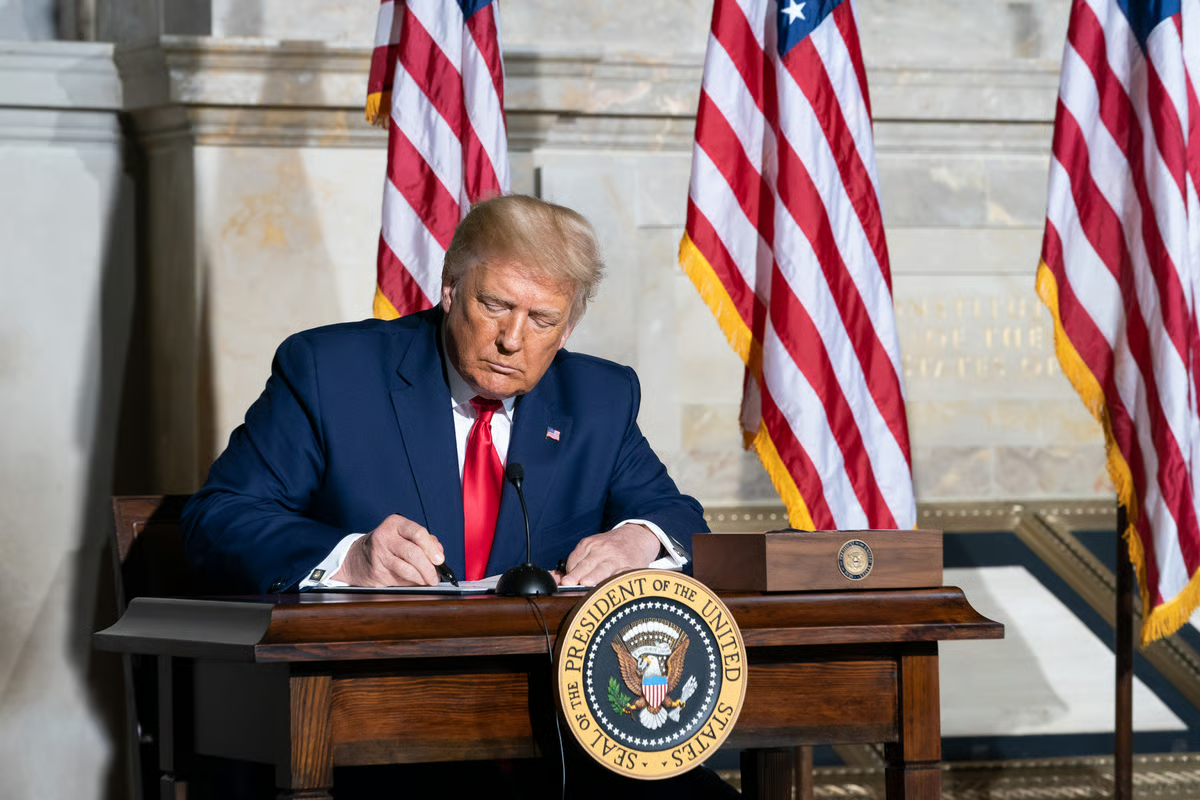
President Trump’s tariffs have coincided with a noteworthy contraction across the U.S. manufacturing sector and a marked downturn in consumer sentiment, raising alarms among investors as the S&P 500 index experiences a rough start to November—a month typically regarded as the strongest for the stock market.
The S&P 500 is down 1.5% for the month so far, following a string of unfavorable economic news and mounting concerns over high valuations in certain sectors, particularly those related to artificial intelligence. In an unusual development, the index recently signaled a valuation warning that has only occurred once in the past 25 years.
Recent data reveals that the U.S. manufacturing sector has seen a continuous decline, with the ISM Manufacturing Purchasing Managers’ Index (PMI) indicating that manufacturing activity has contracted for eight consecutive months. This downturn is starkly evident across all metrics the PMI tracks—orders, production, employment, deliveries, and inventory. ISM Chair Susan Spence noted, “For every positive comment about new orders, there were 1.7 comments expressing concern about near-term demand, driven primarily by tariff costs and uncertainty.”
Contrary to President Trump’s assertions that foreign exporters would bear the brunt of his tariff policies, evidence suggests the financial burden has fallen predominantly on U.S. companies and consumers. Since April, the Consumer Price Index (CPI) has shown consistent inflation growth as tariffs increase costs. Prominent companies have reported significant tariff-related financial impacts; for example, Apple’s CEO Tim Cook disclosed $1.1 billion in additional costs linked to tariffs in the September quarter, with projections of this figure rising to $1.4 billion by December.
Similar pressures are evident among other major corporations. Caterpillar anticipates an impact due to tariffs amounting to approximately $1.6 billion for 2025, while Chipotle’s CFO cited rising beef costs contributing to mid-single-digit inflation. Ford and O’Reilly Automotive also reported billions in potential headwinds due to tariffs. Procter & Gamble raised prices on a quarter of its products as a counter to roughly $1 billion in added costs, and Target’s declines in second-quarter earnings have been largely attributed to these tariffs.
The implications extend to smaller businesses, which comprise the vast majority of U.S. importers. According to the U.S. Chamber of Commerce, 97% of importers are small businesses with fewer than 500 employees, contributing significantly to the value of imported goods. This widespread impact has led Goldman Sachs to project that by 2025, U.S. companies and consumers will bear 77% of the tariff costs, with consumers shouldering approximately half of the price increases.
As the holiday season approaches, consumer sentiment has notably faltered, registering its second lowest reading in history this November, according to the University of Michigan.
In the context of market valuations, the S&P 500’s forward price-to-earnings (P/E) ratio recently surpassed 23—a threshold not observed since 2020, when investors misjudged the pandemic’s effect on global supply chains. Such miscalculations led to inflation spikes and aggressive interest rate hikes by the Federal Reserve, ultimately resulting in a bear market for the S&P 500 in early 2022, with a significant downturn of 25%.
Currently, while the forward P/E ratio has eased to 22.4, it remains considerably higher than both the five-year average of 20 times earnings and the ten-year average of 18.7 times. A return to these averages could see the index decline by 10% to 16%, prompting investors to prepare for potential volatility in the near future.