









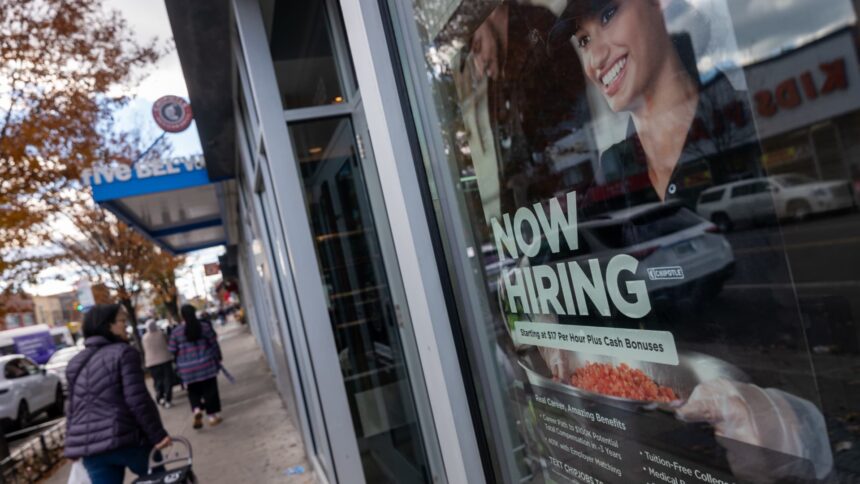
A recent job fair held by the New York State Department of Labor at the Downtown Central Library in Buffalo on August 27, 2025, highlighted ongoing trends in the labor market and their implications for investments. The event drew attention to broader economic themes, particularly as investors grapple with fluctuating employment data.
Yesterday’s market session underscored a well-known adage: adverse news can sometimes serve as a catalyst for stock gains. A report from ADP indicated a surprising drop of 32,000 jobs in November, contrasting sharply with economists’ expectations of a 40,000 job gain. This evident weakness in the labor market fueled a rally in stocks, particularly the Dow Jones Industrial Average, which surged over 400 points. This movement pushed the index into positive territory for the week and sparked speculation surrounding potential interest rate cuts at the upcoming Federal Reserve meeting. Current market sentiment suggests an approximately 89% probability of a rate cut, significantly higher than the 70% likelihood observed just a month ago, as tracked by CME’s FedWatch tool. Concurrently, news from Challenger, Gray & Christmas indicated that this year has seen the highest number of layoff announcements since 2020, further emphasizing the labor market’s deceleration.
Commerce Secretary Howard Lutnick noted that the downturn in job figures might be linked to the recent government shutdown and mass deportations, rather than trade tariffs. Meanwhile, Treasury Secretary Scott Bessent pointed out that the Trump administration could reintroduce substantial tariffs if the Supreme Court determines that the president exceeded his authority in applying these duties.
In corporate earnings news, Salesforce exceeded expectations for quarterly earnings per share, prompting a positive response in premarket trading. However, its revenue, slightly below Wall Street’s forecast, was overshadowed by favorable guidance for the forthcoming quarter and a remarkable 330% year-over-year growth in revenue from the Company’s Agentforce AI software. Salesforce has set an ambitious revenue target of $60 billion for fiscal 2030 for this product.
Nvidia’s CEO Jensen Huang recently visited Washington D.C. for discussions concerning chip export restrictions, notably engaging with Trump and attending a Senate Banking Committee meeting. Huang expressed concerns about the proposed GAIN AI Act, arguing that it poses even greater risks to U.S. innovation than prior legislation aimed at regulating AI. Furthermore, he criticized the notion of state-by-state regulations, warning that such measures could hamper industry progress and raise national security concerns.
In public health news, the Advisory Committee on Immunization Practices, chosen by Health and Human Services Secretary Robert F. Kennedy Jr., is scheduled to vote on whether to maintain its recommendation for newborns to receive hepatitis B vaccinations within 24 hours of birth. Potential changes to this long-standing guideline could significantly influence public health measures, as experts warn it might increase chronic infection rates among children.
Lastly, General Motors has introduced Sterling Anderson as its new Chief Product Officer, a move aimed at revitalizing the automaker’s innovative strategies. Anderson, described as a “Silicon Valley cowboy,” emphasized his goal of accelerating product development and fostering a unified approach to vehicle manufacturing. This strategic change may also benefit from recent decisions to reduce tariffs on imports from South Korea, a nation from which GM is a leading vehicle importer, following Hyundai Motor.
Delta Air Lines also announced the financial impact of the government shutdown, estimating a $200 million hit to pretax profits, representing a 25-cent reduction in current-quarter earnings per share. These evolving economic conditions continue to shape investor sentiment and corporate strategies as stakeholders navigate an increasingly complex landscape.