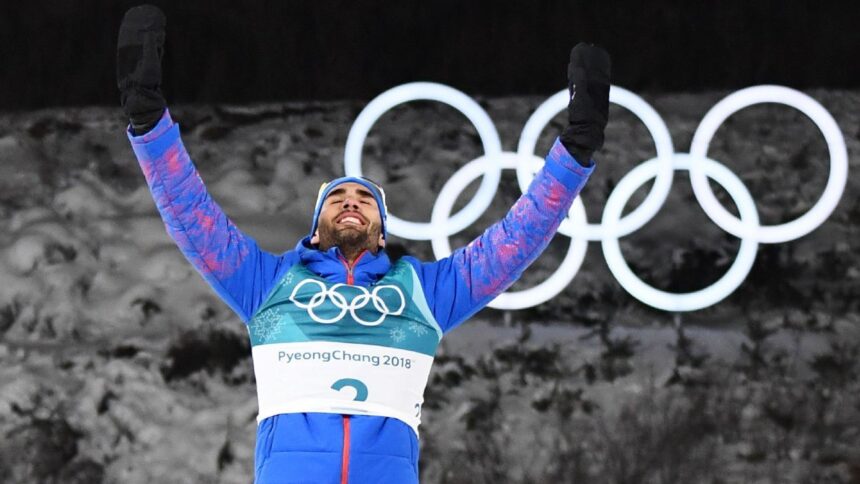
In a significant development in Olympic history, retired French biathlon legend Martin Fourcade has officially been allocated a gold medal, more than 15 years after the Vancouver Olympics. This announcement follows the resolution of a doping case involving Russian athlete Evgeny Ustyugov, which has led to a series of reallocated medals by the International Olympic Committee (IOC).
The IOC’s executive board convened to reassign medals from various events in which Ustyugov won at the 2010 Winter Games in Vancouver and the 2014 Olympics in Sochi. Notably, the revised results from the men’s relay at the Sochi Games have allowed Norwegian biathlon star Ole Einar Bjorndalen to clinch a remarkable 14th career Olympic medal, cementing his status as the most decorated male athlete in Winter Olympic history. With the disqualification of Ustyugov, Norway is now awarded the bronze medal, while the Russian team has been stripped of their previous gold.
Ustyugov’s involvement in a blood doping scandal has been substantiated by rulings from the Court of Arbitration for Sport (CAS) in 2020, with further affirmations on appeal last year. As a result, Ustyugov has faced disqualifications in five Olympic events, paving the way for the IOC to finally allocate medals to deserving athletes.
Initially, Fourcade had secured a silver in the 15-kilometer mass start event in Vancouver, placing him behind Ustyugov. With the new allocation, he will be honored as an Olympic gold medalist for the sixth time in his illustrious career. Now 37, Fourcade has transitioned into an influential role as a member of the IOC, having been elected by fellow athletes during the 2022 Beijing Winter Games. He is expected to receive his new medal in February during the upcoming Winter Games, set to take place in Milan and Cortina d’Ampezzo, northern Italy.
The medal reallocation also impacts other competitors: Pavol Hurajt of Slovakia is now set to receive the silver from the 2010 event, while Christoph Sumann of Austria will be upgraded to bronze. Additionally, in the men’s relay from Vancouver, the disqualification of the Russian team allows Sweden’s team to move up in the standings and secure medals.
The IOC’s decision has also influenced outcomes from the 2014 Sochi Olympics, where medals have been reallocated from a separate doping case involving Ustyugov in the men’s relay. In that instance, Germany has been upgraded to gold, Austria receives silver, and Norway, with Bjorndalen, is now awarded bronze.
Such actions demonstrate the ongoing commitment of international sporting bodies to address doping violations and ensure that rightful athletes are recognized for their achievements. As the sports community anticipates the upcoming Winter Games, the ramifications of these rulings will continue to reverberate through Olympic history.