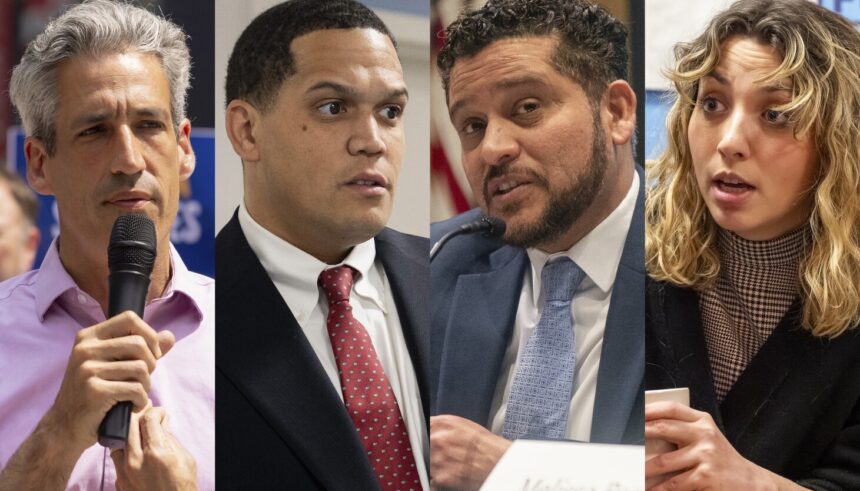
In a high-stakes political climate, various national special-interest groups, notably within the cryptocurrency and artificial intelligence sectors, are pouring substantial resources into four contentious Democratic congressional primaries in the Chicago area. As of the latest reports, super PACs—political action committees that can spend without limits to support or oppose candidates—have collectively exceeded $31.4 million in expenditure, a significant surge compared to previous election cycles.
The spending includes over $6.1 million aimed directly at producing attack ads that are significantly saturating the media landscape as voters approach Tuesday’s primaries. A recent analysis by WBEZ indicates that interests primarily from crypto, AI, and pro-Israel groups account for a staggering $26.9 million of this total.
This current election cycle highlights a dramatic increase in outside financial influence compared to recent primaries without an incumbent. In 2022, Representative Jonathan Jackson’s campaign attracted just over $1.1 million in super PAC support, while Representative Delia Ramirez received around $1.5 million. This year’s candidates are finding themselves bolstered by four times those amounts, largely attributed to contributions from a pro-Israel organization alongside the thriving cryptocurrency and AI industries.
Alisa Kaplan, the executive director of Reform for Illinois, underscored the implications of this financial landscape, expressing concerns over how affluent interest groups could overshadow individual voices in the democratic process. “When some groups can drown out everyone else because of their bottomless pockets… it distorts democracy,” she noted.
The 7th Congressional District, where state Representative La Shawn Ford has secured the endorsement of retiring U.S. Representative Danny Davis, is a focal point of these expenditures. Ford, however, finds himself the target of attack ads due to a past federal bank fraud case. Though the charges against him were ultimately dropped, he pleaded guilty to a minor tax offense in 2014. A super PAC named FairShake, reportedly linked to cryptocurrency interests, has launched a $2.5 million barrage of negative ads against him. Ford has publicly condemned these ads as dishonest, characterizing the claims as misrepresentations of his legal history.
In addition to Ford, FairShake has invested over $817,000 in negative advertising against state Senator Robert Peters, who aims to fill the vacancy left by U.S. Representative Robin Kelly, currently running for the Senate. Peters contended that the cryptocurrency sector is not well-regarded in working-class Black communities and criticized the financial flood aimed at undermining progressive candidates, pejoratively framed as corporate shills.
On a different front, Think Big, a PAC aligned with AI interests, has not engaged in negative campaigning. This organization has supported former U.S. Representative Melissa Bean in the 8th District, investing over $1.1 million into her campaign. While Bean advocates for AI as a beneficial tool, efforts for transparency regarding these financial contributions have gone unanswered.
A significant portion of super PAC spending in these primaries ties back to the American Israel Public Affairs Committee (AIPAC), which has reportedly allocated more than $20.5 million either to back preferred candidates or to attack their rivals. Notably, Chicago Treasurer Melissa Conyears-Ervin has become the top beneficiary of AIPAC funding in the 7th District, with nearly $5 million funneled to support her candidacy.
In the 9th District, state Senator Laura Fine is also reaping financial rewards, receiving nearly $4.4 million from AIPAC-aligned committees, alongside additional funding aimed at undermining her main competitors, Evanston Mayor Daniel Biss and content creator Kat Abughazaleh. Fine has dismissed the notion that external financial contributions would sway her policy decisions as implausible.
As these congressional primaries approach, the significant influx of money from specialized interest groups shapes the political landscape, raising alarm over the potential implications for representative democracy in the Chicago area and beyond.