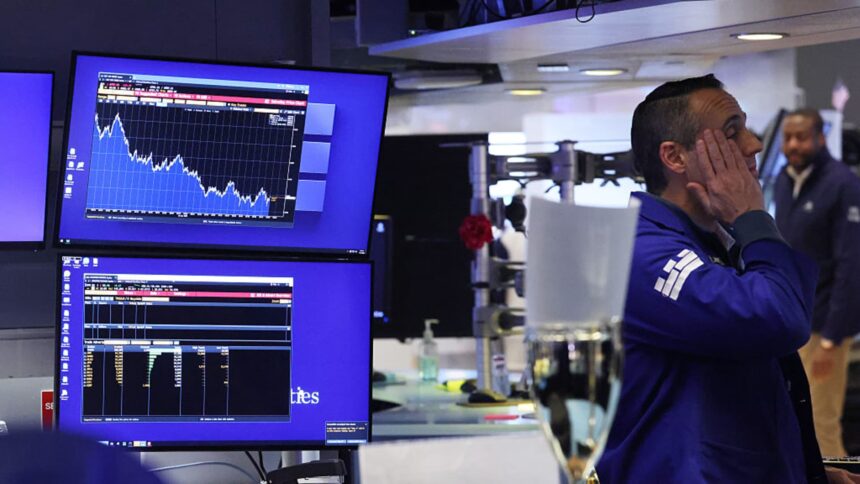
On Thursday, Wall Street experienced a significant downturn, marking its worst day in over a month. Major U.S. indexes reflected this decline, with the Dow Jones Industrial Average plummeting nearly 800 points and the Nasdaq Composite falling by 2%. Despite the sharp drop, the Dow appears set to finish the week with a slight gain, while the Nasdaq is on track to close in the red.
However, a more striking drop occurred within the realm of meme stocks, which saw even larger declines compared to the broader market. The Roundhill Investments’ Meme Stock ETF (MEME), recently relaunched last month, was expected to end the week with a staggering 12% loss as of early Friday morning. Within this fund, several companies have seen extreme dips: Rigetti Computing, a quantum computing firm, is down 43%, while D-Wave Quantum and IonQ have lost 37% and 27%, respectively. Additionally, NuScale Power, a stock linked to AI data center power generation, has collapsed by 48% this week.
Investor Peter Boockvar linked this widespread sell-off to a broader market pullback affecting speculative generative AI stocks. He noted how Oracle has shed 34% of its value since its peak in September and that Meta is trading at its lowest levels since May. “Investors are finally questioning this capex driving into what is still a very uncertain business model of how to monetize all this investment in genAI,” stated Boockvar, who serves as the chief investment officer at One Point BFG Wealth Partners. He suggested that the recent trading shifts signify doubt among investors about future spending by major companies.
Boockvar attributed part of the selling activity to investors looking to realize gains ahead of the year’s end, a trend reflected in declines in other assets like gold and silver. “With the catalyst of people questioning this — the Oracle move, the Meta move — investors are giving a thumbs down to all their spending,” he explained. He warns that if major companies like Oracle and Meta reduce their expenditures, it places all sectors that benefitted from their spending at risk.
The overarching sell-off in the generative AI and data center sectors could have implications that extend beyond the stock market to impact the U.S. economy as a whole. “It’s very hard to have this be contained when its tentacles reach so far and wide in terms of the S&P,” Boockvar observed. “With nearly 40% of the S&P involved in this trade, if it collapses, it’s difficult to see how the remaining 60% will sustain market levels.”