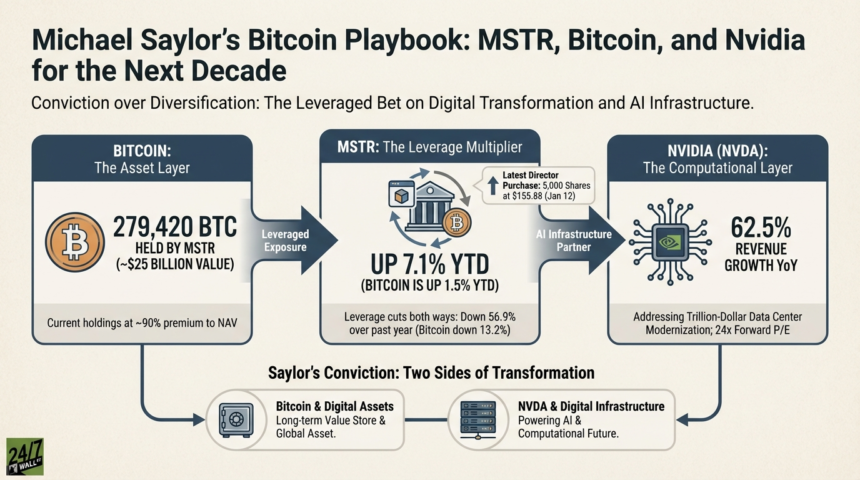
In a bold assertion, Bitcoin maximalist Michael Saylor has named both Bitcoin and Nvidia (NASDAQ: NVDA) as the top performing assets for the upcoming decade, signaling a strong conviction in the convergence of digital assets and infrastructure. Saylor, the executive chairman of MicroStrategy (NASDAQ: MSTR), has long been a proponent of Bitcoin, steering the company from a struggling software firm into one primarily focused on cryptocurrency holdings.
The recent activity within MicroStrategy’s leadership reflects this strategic shift. On January 12, a director purchased 5,000 shares at $155.88, marking the first open-market purchase at the director level in months. This occurs against the backdrop of substantial insider selling seen last year, when executives disposed of shares when prices ranged from $200 to $250. The reversal from heavy selling to buying—particularly after a 24% drop in stock price—suggests a significant change in sentiment among insiders.
Under Saylor’s direction, MicroStrategy has adopted a unique financial strategy: issue stock and debt to purchase Bitcoin, then repeat this cycle. The company currently holds a staggering $73.2 billion in Bitcoin while carrying $8.2 billion in long-term debt. This approach is not merely a hedge; it represents a leveraged investment in cryptocurrency.
Saylor’s pairing of Bitcoin with Nvidia isn’t arbitrary. He envisions digital assets and infrastructure as integral components of a broader digital transformation. Bitcoin acts as the asset layer, while Nvidia provides the computational resources necessary for driving advancements in artificial intelligence (AI). Saylor argues that AI will be a significant force in creating value over the next decade.
So far this year, Bitcoin has risen 1.5%, while MicroStrategy’s stock has increased by 7.1%, showcasing MSTR’s leverage on Bitcoin’s price movements. However, this leverage poses risks. Over the past year, Bitcoin has decreased by 13.2%, leading to a dramatic 56.9% plunge in MSTR stock. Currently, MSTR trades at 7x trailing earnings, but that figure is largely misleading—as investors are not primarily drawn to its software revenue of $128.7 million. Instead, the focus is on its impressive Bitcoin holdings, which are valued around $25 billion at current market prices, relative to a market cap of $47.4 billion. Investors thus pay a 90% premium to net asset value based on Saylor’s investment strategy.
The bullish scenario predicts that if Bitcoin rises to $150,000, MSTR stock would significantly increase, allowing the company to issue more shares at inflated prices to acquire more Bitcoin. For institutional investors who cannot directly hold Bitcoin, an investment in MSTR offers a useful alternative.
Conversely, the bearish perspective outlines the potential risks of leveraged exposure. MicroStrategy’s substantial debt means that in the event of a prolonged downturn in Bitcoin prices, the premium investors pay could collapse. This may result in significant dilution of shares as the company might issue more stock to manage debt or buy extra Bitcoin at lower prices. Meanwhile, MicroStrategy’s core software business exhibited only a modest 10.9% growth in revenue year-over-year, while earnings plummeted by 77.5%.
The recent purchase by Director Carl Rickertsen, acquired at a price substantially lower than the $377 high last year, indicates a level of inside confidence in the company’s strategy.
Turning to Nvidia, the semiconductor giant recently announced impressive financial results, generating $57 billion in revenue with a staggering 62.5% increase year-over-year and a net income of $31.9 billion. The company boasts a 53% profit margin and a 107% return on equity, highlighting its profitability as it captures a substantial share of the AI-driven infrastructure market. Analysts are largely optimistic about Nvidia’s stock, with 60 out of 64 analysts recommending it as a buy, suggesting continued growth in the coming years.
Nevertheless, the trend of insider selling raises questions about the sustainability of Nvidia’s valuation. Key executives, including CFO Colette Kress and CEO Jensen Huang, have sold significant numbers of shares recently, signaling potential diversification rather than a robust belief in the company’s future.
For Saylor, this strategy hinges on the belief that AI infrastructure will be critical to the next phase of digital transformation, and if this vision materializes, both Bitcoin and Nvidia could prosper.
However, such concentrated investments come with inherent risks, particularly for more conservative investors. With MSTR’s beta at 3.43 and NVDA’s at 2.31, these stocks exhibit high volatility—suggesting considerable price swings could occur. If an investor cannot endure significant fluctuations in value, Saylor’s high-conviction strategy may not be suitable. Yet, for those who maintain faith in the potential of Bitcoin and AI infrastructure over the long term, these two companies represent key opportunities in the rapidly evolving digital economy.