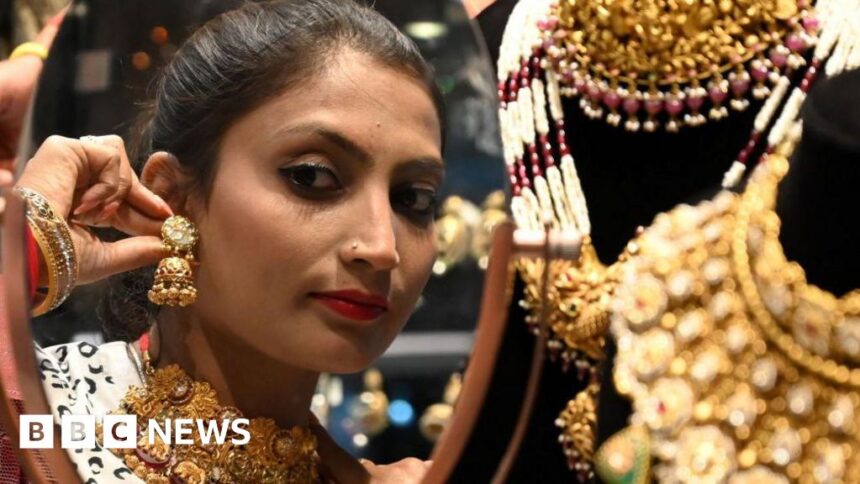
As Diwali approaches, the bustling jewellery market in Lajpat Nagar, Delhi, is witnessing an influx of shoppers eager to purchase gold. Despite rising gold prices that have recently exceeded $1,440 (£1,081) for just 10 grams, many consumers are still drawn to the allure of gold during this auspicious time. The festivals of Diwali and Dhanteras—what many consider prime occasions to acquire precious metals—have motivated a surge in foot traffic at local jewellery stores.
Prakash Pahlajani, the owner of Kumar Jewels, reported an increase in customers this year, attributing this to a mix of cultural tradition and a sense of urgency sparked by soaring prices. “People are concerned that prices might rise even further, leading to what can be described as a fear of missing out,” he stated. However, high prices—gold has escalated by 60% this year, and silver by 70%—have compelled jewellers to adapt their offerings to meet customer budgets.
Rather than abandoning their desire for gold, consumers are simply modifying their purchasing behavior. Tanishq Gupta, another jeweller in the area, noted that customers are opting for lighter jewelry, finding innovative ways to create visually appealing pieces that contain less gold. For instance, he sells a 250mg gold coin for around $35, designed to appear larger than its weight. He has also introduced coins as light as 25mg to cater to a shifting demand landscape focused on affordability.
Moreover, retailers pointed out a rising trend: consumers are increasingly buying gold and silver as investments rather than solely for adornment. Data from the World Gold Council (WGC) reveals a substantial transformation in consumer behavior; investment demand has surged, while the share of gold jewellery in overall gold demand has decreased significantly. In the second quarter of this year, the jewellery segment accounted for just 64% of gold demand, down from 80% a year earlier, while investment demand surged from 19% to 35%.
This shift is supported by growing interest in exchange-traded funds (ETFs) and digital gold, with record inflows observed in recent months. The Reserve Bank of India’s (RBI) active purchasing of gold for its foreign exchange reserves has also shaped the market, with the share of gold rising from 9% to 14% since 2025. Analysts indicate that the RBI’s strategy is designed to diversify its reserves and mitigate reliance on the U.S. dollar.
Despite the high prices, experts predict that retail demand will remain resilient, particularly as the festive and wedding seasons unfold. However, there is concern that lower-income families may face challenges affording their desired purchases. Bhavna, a bride-to-be, expressed her apprehensions about her wedding shopping, citing that rising prices have forced her to reconsider her budget.
The deep cultural connection to gold, especially in the form of jewellery, is unlikely to wane in the long term, even as short-term fluctuations continue to affect consumer purchases. According to research from Morgan Stanley, Indian households collectively hold around $3.8 trillion in gold, a significant asset amounting to 88.8% of the country’s GDP. This substantial ownership implies a strong positive wealth effect, enriching many families during challenging economic times.
As this festive season commences, the spotlight remains on the resilience of India’s gold market and its enduring allure, even as rising prices have somewhat dulled its shine.