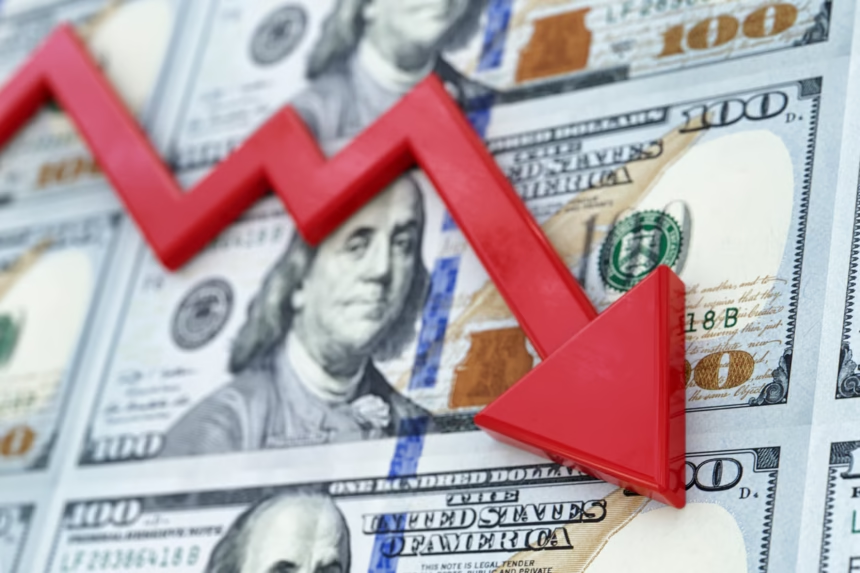
More than half of U.S. investors are expressing pessimism about the future of the market, according to the latest weekly survey conducted by the American Association of Individual Investors. This finding, released on March 18, 2026, reveals that 53% of participants view market conditions unfavorably, a notable rise from 46% the previous week and a significant leap from just 35% two weeks prior.
As sentiments around potential market volatility grow increasingly negative, it’s critical for investors to reassess how their portfolios might fare during a market crash or recession. There are both positive and negative considerations for those currently invested in the market.
Historically, the long-term outlook for the stock market remains optimistic. However, the short-term landscape is unpredictable. Should a bear market or recession occur, investments are likely to experience a decline in value. Take the Great Recession as a stark example: the S&P 500 lost over 50% of its value from 2007 to 2009. If an investor had placed $10,000 into an S&P 500 ETF in December 2007, that portfolio would have plummeted in value to approximately $4,600 by March 2009.
It’s important to note, however, that a decline in value does not equate to a realized monetary loss. The actual loss occurs only if an investor sells their shares for less than the original purchase price. In the previous scenario, holding on to the investment during the downturn would have spared the investor from locking in a loss. In fact, an investor who maintained their $10,000 investment in the S&P 500 ETF over a decade would have seen their portfolio more than double in value.
Investors are advised to adopt a long-term perspective as a strategy to navigate market uncertainties. While short-term fluctuations can be disconcerting and lead to fluctuating valuations, historical data indicates that the overall market tends to yield positive returns over ten to twenty years.
To enhance the chances of portfolio resilience, it’s crucial for investors to focus on the quality of their stock selections. While the market as a whole has a strong track record of recovery, individual companies can vary significantly in their ability to weather downturns. Companies that exhibit solid financial health and possess distinct competitive advantages are more likely to recover even after a significant decline. In contrast, companies lacking strong fundamentals might thrive during prosperous times but could falter in a recession.
Maintaining a diversified portfolio that emphasizes robust, financially sound companies can help mitigate potential risks. Although a turbulent short-term environment is normal, holding onto quality investments for several years can significantly increase the likelihood of weathering any market crises.