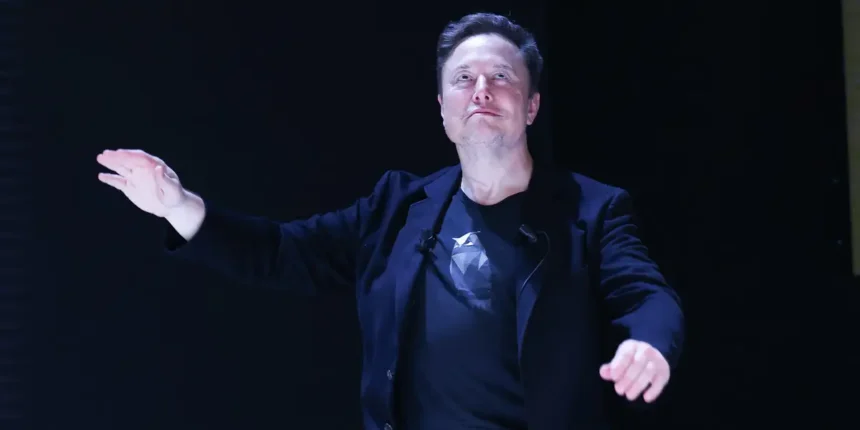
In a bold and visionary announcement, Elon Musk detailed his ambitious plans for the Terafab project during a presentation at the historic Seaholm Power Plant in Austin. framing it as an initiative aimed at creating a “galactic civilization.” The Terafab represents a significant chip manufacturing effort that merges the technological prowess of Musk’s companies, including Tesla and SpaceX, alongside his recently acquired AI startup, XAI.
Musk emphasized the challenges of establishing a chip manufacturing plant, describing it as a “herculean” task. Analysts from Morgan Stanley noted that the complexities involved in chip production, including substantial financial investments and the need for specialized technology, have led to a division within the industry between fabless companies like Nvidia and foundries such as TSMC.
The Terafab, according to Musk, is crucial for scaling projects like robotaxis and Tesla’s humanoid robot, Optimus, as well as for developing “space-based compute.” He highlighted that the facility will be dedicated to creating chips specifically designed for space, intending to deploy solar-powered AI satellites that could revolutionize data processing in orbit.
One of Musk’s key takeaways from the announcement was the comprehensive nature of the Terafab. He described it as an all-in-one manufacturing plant that consolidates various stages of chip development typically carried out separately. Musk asserted, “To the best of my knowledge, this doesn’t exist anywhere in the world,” referring to the integrated approach that encompasses design, testing, revising, and even packaging of chips.
The Terafab will produce two primary types of chips. The first is focused on optimizing the functionality of Optimus and Tesla vehicles, which are progressing towards full autonomy. Musk suggested that the demand for these chips will be significantly greater than for traditional vehicles, anticipating production volumes that could be 10 to 100 times higher.
The second type, known as the D3 chip, is designed for the unique conditions of space. Musk underscored a vision in which most data centers would operate in low Earth orbit, leveraging the constant sunlight to power solar-equipped AI satellites. He asserted that the cost of deploying AI in a space environment could fall below that of similar terrestrial systems, largely due to the unceasing availability of solar energy.
Illustrating his vision for a expansive AI network, Musk shared plans for mini AI satellites that would harness solar energy to provide around 100 KW of power. He optimistically forecasted that future satellites could achieve power outputs in the megawatt range, proposing them as ideal solutions to avoid placing data centers on land, where they might be met with public opposition.
Looking further into the future, Musk outlined a daring plan to establish an industrial base on the moon, which he argued could facilitate the generation of petawatts of AI computing power—an enormous increase compared to existing capacities. He also envisioned a post-scarcity world where travel to distant planets like Saturn might become a reality, describing his “abundance” proposal with a humorous nod to its ambitious nature, likening it to the satirical depiction in the film “Idiocracy.”
Through this ambitious undertaking, Musk is not merely proposing advancements in technology; he is advocating for a revolutionary shift in how humanity could harness AI and space for future endeavors.