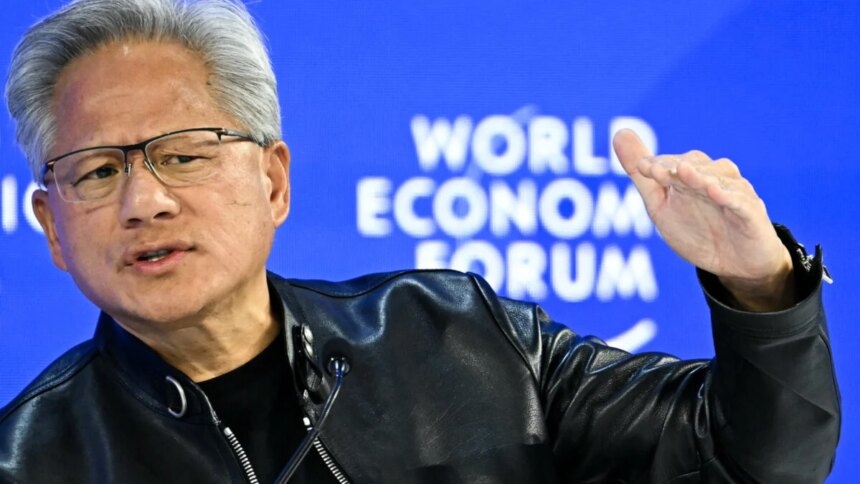
Nvidia unveiled impressive earnings figures in its latest report, predominantly buoyed by its data center segment, which accounted for over 91% of total sales. The company reported a staggering revenue of $193.7 billion from this unit, marking a significant 68% increase year-over-year. Nvidia’s Chief Financial Officer, Colette Kress, highlighted the rapid growth, stating, “We have now scaled our data center business by nearly 13x since the emergence of ChatGPT in fiscal 2023.”
This growth comes as global AI spending is projected to hit $2.5 trillion this year. Major AI hyperscalers—including Amazon, Alphabet, Meta, and Microsoft—recently reported record capital expenditure figures. However, the hyperscalers have also made substantial commitments for 2026, nearing $700 billion, raising concerns among some investors about the sustainability of such aggressive spending. Evercore analysts had earlier cautioned that this extensive capital investment could lead to negative cash flow for these companies.
Despite the significant financial commitments made to bolster AI infrastructure, some experts express caution. A Goldman Sachs analyst recently suggested that AI’s contribution to the U.S. GDP in 2025 could be “basically zero,” highlighting a disconnect between investment and observable economic impact. Nvidia CEO Jensen Huang defended the hyperscalers’ capital expenditure during the earnings call, expressing confidence in their cash flow growth. He emphasized the emergence of “agentic AI” and its utility across various enterprises, suggesting that this trend would ultimately validate the substantial investments being made.
Huang asserted that AI adoption beyond the tech sector is critical. The lack of tangible productivity gains and revenue returns from AI integration remains a concern. A recent survey revealed that while 70% of firms utilize AI, over 80% claimed no discernible impact on employment or productivity. OpenAI’s COO, Brad Lightcap, emphasized last week that enterprise AI has yet to permeate business processes effectively.
Looking forward, some experts view the recent launch of Anthropic’s Claude Cowork as a potential catalyst for AI’s deeper integration into the workforce. Huang also acknowledged Claude Cowork in his remarks, indicating that it might significantly influence the industry landscape. He articulated a crucial point during the call: “In this new world of AI, compute equals revenues.” Huang underscored the importance of tokens—small data units processed by AI models—asserting that as models grow in complexity, so too does the demand for computing power, which in turn drives revenue.
He forecast that the world’s need for token generation far exceeds $700 billion, suggesting that all companies relying on software will also require AI, thus leading to an ongoing generation of tokens. According to Huang, the infrastructure investments in data centers will directly correlate to increased revenue as AI technologies evolve.
Despite the robust earnings report, Nvidia’s stock performance exhibited some volatility. Although shares initially surged in response to the positive earnings announcement, they ultimately settled to less than a 1% gain following Huang’s remarks.
Further complicating Nvidia’s outlook are uncertainties regarding its partnership with OpenAI and its operations in China. Concerns about a rift with OpenAI arose after reports indicated that a significant investment from Nvidia had stalled, coupled with claims that Huang had privately criticized OpenAI’s business approach. During the earnings call, Huang consistently praised OpenAI’s contributions and noted that discussions about the partnership were ongoing, although he refrained from providing guarantees regarding the finalization of any agreement.
In addition to its business dynamics with OpenAI, Nvidia is also navigating a complex landscape regarding its operations in China. The Trump administration recently authorized limited shipments of its H200 chips to China, a market that Nvidia previously dominated before facing significant trade restrictions. However, executives remain uncertain about the long-term outlook for these shipments and have not included them in their expected revenue projections for the year.