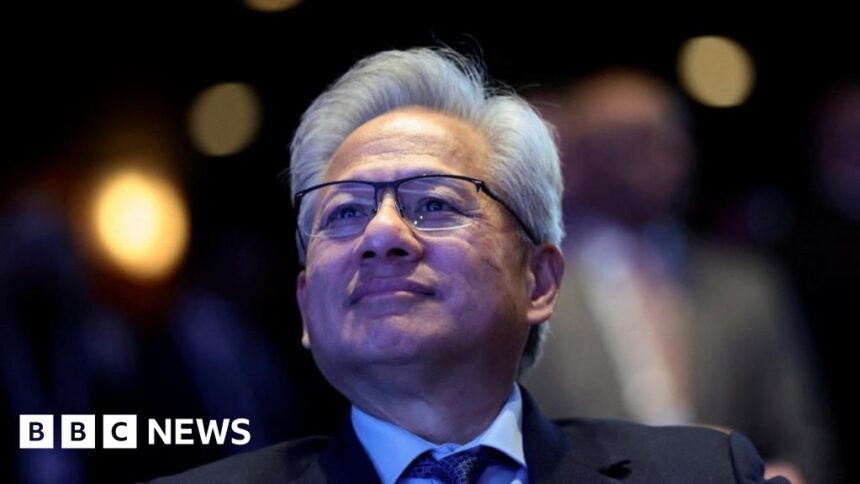
During a dynamic presentation at the CES technology conference in Las Vegas, Jensen Huang, the CEO of Nvidia, introduced a groundbreaking tech platform named Alpamayo, aimed at revolutionizing the capabilities of self-driving cars. Huang described Alpamayo as a pivotal advancement, enabling autonomous vehicles to “think through rare scenarios, drive safely in complex environments, and explain their driving decisions,” marking a significant step towards making AI systems more human-like in their reasoning.
In conjunction with this announcement, Huang revealed that Nvidia has commenced production of a driverless car, the Mercedes-Benz CLA, leveraging its cutting-edge technology. This vehicle is set to be launched in the U.S. in the upcoming months, followed by releases in Europe and Asia.
Dressed in his signature black leather jacket, Huang expressed that the project had yielded invaluable insights into advancing partnerships in the development of robotic systems. Analysts interpret this move as a testament to Nvidia’s dominance in the integration of AI hardware and software, further solidifying its position in the expanding physical AI landscape. Paolo Pescatore, an analyst at PP Foresight, noted that Nvidia’s shift towards AI at scale will keep it significantly ahead of competitors, marking a transition from a primarily computing-focused entity to a comprehensive platform provider for physical AI ecosystems.
Following Huang’s presentation, Nvidia’s shares experienced a slight uptick in after-hours trading. The presentation included a compelling video demonstration showing the AI-powered Mercedes-Benz gracefully navigating the streets of San Francisco, with a passenger seated behind the wheel, hands resting in their lap. Huang emphasized the vehicle’s natural driving proficiency, stating it was trained directly from human drivers and excelled in communicating its intentions during various driving scenarios.
Alpamayo is characterized as an open-source AI model, with its foundational code accessible through the Hugging Face machine learning platform. This allows researchers focused on autonomous vehicles to utilize and further refine the model at no cost. Huang articulated a visionary goal, stating, “someday, every single car, every single truck, will be autonomous.”
Nvidia is also planning to launch a robotaxi service next year, collaborating with an unnamed partner for this initiative, though specific details about the partnership and operational locations remain undisclosed.
As the dominant player in the AI chip market, Nvidia holds a market capitalization exceeding $4.5 trillion and was the first company to achieve a $5 trillion valuation last October amidst the surging AI wave. However, concerns have emerged regarding the sustainability of demand for AI technology, prompting some shifts in the company’s market valuation.
In addition to the Alpamayo announcement, Nvidia disclosed that its highly-anticipated Rubin AI chips are currently in production, slated for release later this year. These advanced chips are designed to operate with greater energy efficiency compared to Nvidia’s existing AI products, potentially lowering the overall costs associated with AI development.