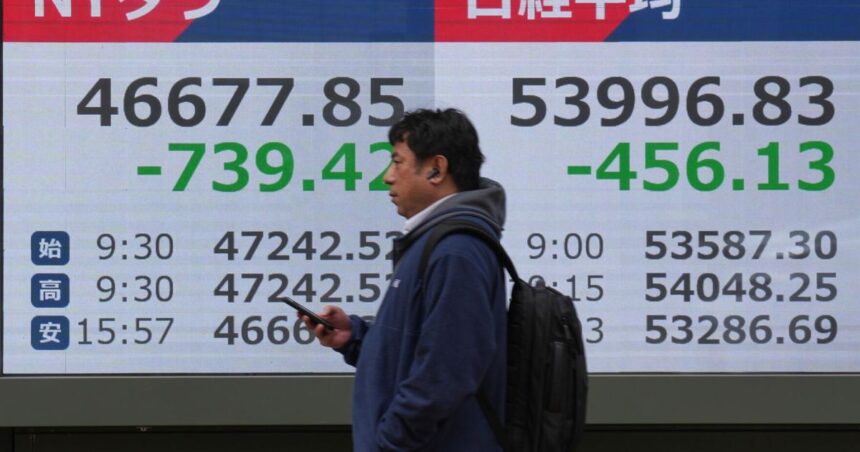
Oil prices experienced a notable decline on Monday, resulting in a significant uptick in stock prices amid ongoing geopolitical tensions stemming from the war in Iran. The S&P 500 Index rose 1%, on track for its best performance in five weeks. The Dow Jones Industrial Average climbed by 379 points, or 0.8%, while the Nasdaq composite increased by 1.3%.
The fluctuations in market performance were heavily influenced by changes in oil prices. Benchmark U.S. crude oil fell by 3.4%, landing at $95.36 per barrel, a marked decline from a peak of over $102 earlier in the day. Meanwhile, Brent crude, the international standard, dropped 0.9% to $102.20, after reaching highs of $106.50.
This reprieve in oil prices is welcomed, especially as they had surged from around $70 due to military actions involving the United States and Israel against Iran. The conflict has led to significant disruptions in the Strait of Hormuz, a crucial passage through which a fifth of the world’s oil is transported. The closure of this strategic route has compelled oil producers to reduce output, as their crude oil has limited distribution options. Market analysts express concern that prolonged disruptions could escalate inflation to levels detrimental to the global economy.
In a related development, President Donald Trump urged other nations affected by the closure of the Strait of Hormuz to “take care of that passage,” pledging substantial U.S. support. Concurrently, European allies are seeking clarity on Trump’s strategy regarding the war and its potential duration.
Historically, the U.S. stock market has demonstrated resilience, often rebounding swiftly from military conflicts, provided oil prices do not remain elevated for extended periods. Currently, many investors remain optimistic that such a rebound will occur again, contributing to stock prices that are close to record levels despite recent volatility. Notably, the S&P 500 is only about 4% shy of its all-time high.
Escalating tensions in the conflict prompt speculation that both sides may face pressures that could thwart a prolonged engagement, according to Paul Christopher, head of global investment strategy at Wells Fargo Investment Institute.
As Wall Street reacted positively to falling oil prices, stocks of companies with substantial fuel expenses surged. Norwegian Cruise Line Holdings gained 4.6%, while United Airlines appreciated 3.1%, recovering from earlier losses this year. National Storage Affiliates experienced a remarkable 29.4% increase following Public Storage’s announcement of a $10.5 billion all-stock acquisition. Public Storage, however, saw a decline of 2.2%. Dollar Tree’s stock rose by 7.3% after the company reported stronger-than-expected quarterly profits despite a decrease in foot traffic.
In technology, Nebius Group saw a stock surge of 15.3% after securing a five-year infrastructure contract with Meta Platforms, valued at up to $27 billion. Meta’s shares rose 1.9%, while Nvidia stock, buoyed by the growing demand for its AI chips, increased by 2.5%, becoming a major contributor to the S&P 500’s performance. Anticipation grew around an upcoming speech from Nvidia’s CEO, Jensen Huang, who might unveil new products.
International markets also reflected the positive sentiment, with European indexes rising, including Germany’s DAX, which saw a return of 0.5%. In Asia, stocks increased by 1.4% in Hong Kong, although Shanghai experienced a slight dip of 0.3%.
In the bond market, Treasury yields eased amidst the declining oil prices, alleviating some inflation concerns. A report indicating weakened manufacturing activity in New York state further influenced these yields. The yield on the 10-year Treasury bond decreased to 4.24% from 4.28% at the end of the previous week, though it remains above pre-war levels of approximately 3.97%. Traders have adjusted their expectations regarding the timing of potential Federal Reserve interest rate cuts due to the oil price surges linked to the conflict, with predictions suggesting no imminent reductions following the upcoming Fed meeting.