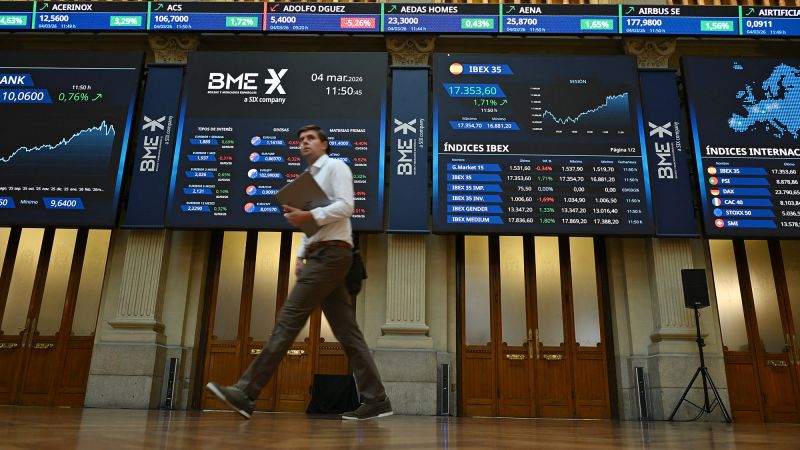
Oil prices took a breather on Wednesday, providing relief to European and US stock markets after a period of significant fluctuations driven by escalating tension in the Middle East. Investors remain cautiously optimistic about the potential for limited long-term disruptions in energy supplies following developments associated with the ongoing conflict involving the United States and Iran.
Global markets continue to navigate the fallout from this unrest, especially in Asia, where stock indices experienced sharp declines. Notably, South Korea and Japan’s economies are particularly vulnerable as both countries rely heavily on liquified natural gas imports from the Middle East. The South Korean benchmark Kospi index plummeted 12%, following a steep drop of 7.24% just one day prior, propelling it close to a technical bear market. Despite this downturn, the Kospi is still up nearly 21% for the year, having previously thrived in 2025 due to surging interest in artificial intelligence and semiconductor stocks. Analysts at Capital Economics emphasized the fragility of these markets given their dependence on LNG for energy supplies.
In stark contrast, US and European stocks gained ground midweek, aided by a report from the New York Times indicating that Iran had initiated indirect negotiations with the United States aimed at resolving the conflict. The announcement helped sate fears of further escalation. In addition, Treasury Secretary Scott Bessent confirmed that the US Navy is prepared to ensure “safe passage” for oil tankers through the Strait of Hormuz when necessary, echoing statements from President Trump that contributed to the easing of oil prices.
Despite the recovery in some markets, experts warn that risks linger for investors. Matt Maley, chief market strategist at Miller Tabak + Co, noted that the stock market is currently reflecting an overly optimistic scenario amidst ongoing geopolitical tensions. The trend of diversifying investments into European and Asian markets has taken a hit, particularly with Asia facing severe disruptions. Japan’s Nikkei 225 has dropped about 8% this week, on track for its worst performance since March 2020.
On the commodities front, US crude oil prices fell slightly to $74.32 per barrel, while Brent crude dipped to $81.25. This moderation in oil prices followed two days of dramatic increases, which had pressured global stock markets. In the US, major indices showed resilience; the Dow Jones Industrial Average rose by 330 points, or 0.68%, while the S&P 500 and Nasdaq gained 0.86% and 1.4%, respectively. These indices remain only slightly lower for the week.
Gasoline prices rose by approximately 9 cents, nearing $3.20 per gallon, reinforcing the pressures of rising energy costs. In contrast, US natural gas futures dropped by 4.2%, reversing Tuesday’s gains, and US diesel futures remained flat but have surged nearly 23% this week.
In Europe, natural gas and diesel prices saw declines of 9% and 3%, respectively, after experiencing sharp increases earlier in the week. However, they are still up significantly over the course of this week, rising by 55% and 30%, respectively.
Analysts expect that while the war in the Middle East continues to present challenges, markets have found temporary stabilization. John Canavan, lead analyst at Oxford Economics, stated that President Trump’s promises regarding naval escort for vessels have played a crucial role in calming energy prices and stabilizing broader markets while awaiting further developments.
Amid these fluctuations, US Treasury yields crept higher as investors reacted to the potential inflationary pressures stemming from increased energy costs. The 10-year yield climbed to 4.08%, marking its highest point in two weeks. Although this surge reflects concern about inflation, yields remain relatively low.
The US dollar experienced a pullback against other major currencies, halting a strong two-day ascent. Gold prices edged up by 0.9%, although it is down 1.5% for the week, showcasing traditional safe-haven trends. Meanwhile, Bitcoin surged over 7%, rising above $71,000.
Economic strategists, such as Thierry Wizman from Macquarie Group, continue to emphasize the uncertainty surrounding prolonged conflict in the Middle East. Speculation persists regarding how far the situation could escalate and its potential impact on global energy supplies, as well as on civilian infrastructure in affected Gulf nations.