The economic landscape is increasingly echoing the tumultuous 1970s, as rising oil prices, a sluggish job market, and dampening growth bring forth concerns reminiscent of stagflation. Once again, Iran finds itself at the heart of these economic troubles, a stark reminder of the past when oil crises severely impacted daily life.
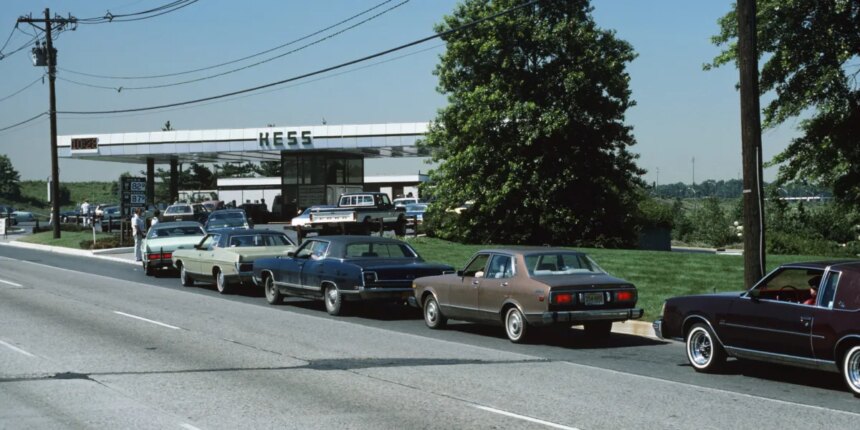
In the 1970s, the Arab oil embargo and Iran’s Islamic revolution significantly disrupted oil supply chains, resulting in long lines for gas as rationing took hold. Today, the U.S.-Israel conflict with Iran is pushing crude oil prices above $100 per barrel. The Iranian regime’s Islamic Revolutionary Guard Corps (IRGC) has been implicated in attacks on tankers navigating the Strait of Hormuz, a vital shipping route responsible for 20% of global crude oil movement, effectively imposing a blockade.
Recent economic indicators paint a troubling picture, with the latest jobs report revealing an unexpected decline in employment, continuing a trend of meager net gains over the past year. Growth forecasts are also being adjusted downward, as initial projections for a 3.2% GDP increase in the first quarter have been revised to just 2.1%.
While oil prices have recently dipped slightly as Western nations plan to release strategic reserves and escort tankers, the risk of further disruptions remains a pressing concern. Veteran market strategist Ed Yardeni highlighted that as long as IRGC continues to operate drones in the region, there will be significant risk to safe maritime passage. Despite President Donald Trump’s authorization of U.S. Navy escorts for ships through the vital strait, the implementation of these measures could lag, and their effectiveness in preventing Iranian attacks may be uncertain.
In light of these ongoing threats, Yardeni has adjusted predictions regarding a potential stock market downturn reminiscent of 1970s stagflation, increasing the likelihood from 20% to 35% for this year. He remains cautiously optimistic, maintaining a 60% chance of continued growth, likening the current era to the “Roaring 2020s,” while lowering the chances of a significant market surge to just 5%.
His outlook for the decade has been narrowed considerably, now envisioning an 85% chance of the Roaring 2020s continuing, against a 15% likelihood of a stagflation scenario. The current economic predicament, as Yardeni suggests, reflects a precarious balancing act for the U.S. economy and the Federal Reserve, caught between rising inflation and increasing unemployment pressures.
Historically, spikes in oil prices have coincided with economic downturns. However, the U.S. managed to avoid a recession following last year’s oil price surge post-Russia’s invasion of Ukraine, thanks in part to a resilient economy and its position as a leading energy producer. This reduced reliance on imports positions the U.S. favorably, contributing to a more optimistic economic outlook despite current challenges.
Yardeni anticipates a possible market correction of 10% to 15% rather than a full-blown bear market involving a decline of 20% or more, though he acknowledges that this scenario cannot be entirely disregarded. He posits that once shipping through the Strait of Hormuz stabilizes, a bull market in stocks would likely resume.
However, the conflict with Iran carries inflationary risks beyond just energy prices. Gulf nations are also significant exporters of fertilizers, and should shipping through the Strait not resume by early April, farmers may be compelled to use alternative fertilizers or reduce their usage. This shift could ultimately lead to diminished agricultural yields, potentially instigating a secondary “food price shock” by late 2026, according to Yardeni’s forecast.