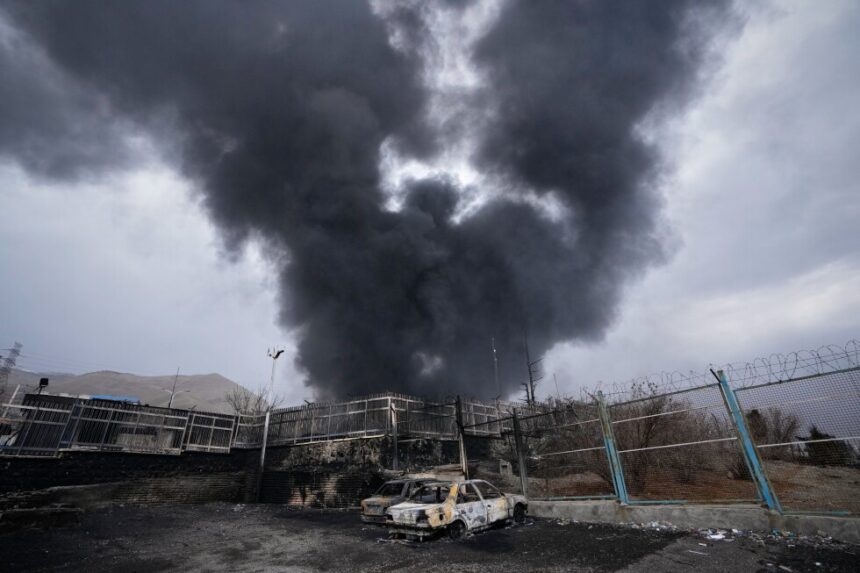
Oil prices experienced extreme fluctuations on Monday amid escalating tensions in the Middle East, primarily due to the intensifying conflict involving Iran. Early in the day, Brent crude soared to an alarming $119.50 per barrel but later settled at $107.80. Similarly, West Texas Intermediate, the U.S. light sweet crude benchmark, jumped to $119.48 before easing back to $103.
The conflict has significantly impacted civilian infrastructure, with Bahrain accusing Iran of targeting a crucial desalination plant essential for drinking water supplies. Concurrently, reports emerged of Israeli airstrikes resulting in flames engulfing oil depots in Tehran, exacerbating concerns over supply shortages.
The second week of the ongoing war has disrupted oil production and transportation networks across the Persian Gulf, crucial for global oil and gas supply. Approximately 15 million barrels of crude oil, accounting for about 20% of daily global oil shipments, traverse the Strait of Hormuz. However, heightened fears of missile and drone attacks from Iran have led to a substantial reduction in tanker operations in the region.
Production cuts have emerged from Iraq, Kuwait, and the United Arab Emirates due to overflowing storage facilities stemming from their diminished export capabilities. The recent military actions by Iran, Israel, and the U.S. targeting oil and gas infrastructure further exacerbate the mounting supply concerns.
Market responses to the fluid situation were notable, with global financial markets reacting negatively to the spike in oil prices. The Tokyo benchmark Nikkei 225 index fell by 5.2%, and U.S. stock futures dipped more than 1.5%, continuing a trend from the previous week that saw significant declines in indices like the S&P 500 and Dow Jones.
Rising energy prices are trickling down into various sectors, putting additional strain on Asian economies that rely heavily on imports from the Middle East. The last time oil prices approached these levels was in 2022 following Russia’s invasion of Ukraine. Higher energy costs contribute to inflation, placing additional pressure on household budgets and dampening consumer spending, which is vital for many larger economies.
In the U.S., gasoline prices also surged, with a gallon of regular gasoline rising to approximately $3.45, an increase of 47 cents from the previous week. Diesel prices surged to about $4.60 per gallon, a rise of around 83 cents.
Energy Secretary Chris Wright expressed optimism during an interview on CNN, stating that U.S. gas prices could return to below $3 per gallon in the near future, though he acknowledged the uncertainties in timing. Some analysts warn that sustained oil prices above $100 per barrel could have devastating effects on the global economy.
Iran’s parliament speaker highlighted the catastrophic implications of the war on the oil industry, as Iranian authorities confirmed casualties from the Israeli attacks. Iran’s oil exports, primarily to China, could face disruptions, creating additional strains on energy prices globally. Natural gas prices also saw an uptick during the conflict, with prices inching up to about $3.33 per 1,000 cubic feet, representing a 4.6% increase from the previous week.