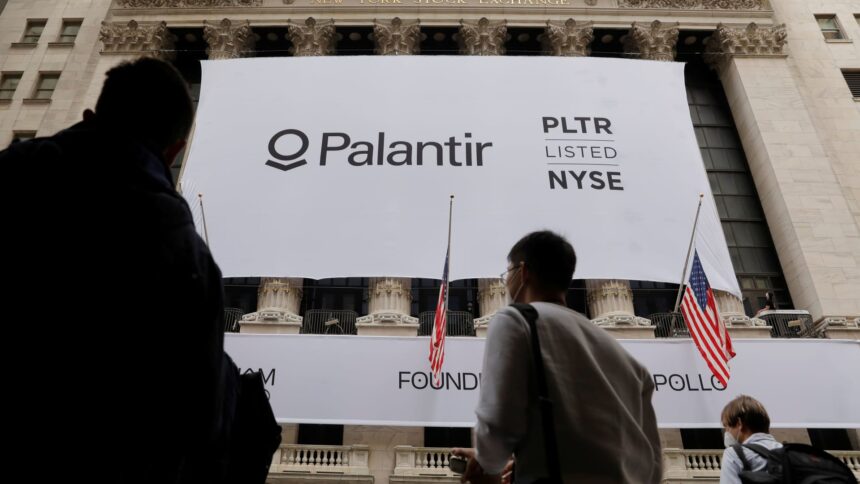
Palantir Technologies, which made its debut on the New York Stock Exchange in September 2020, has experienced a meteoric rise that few could have predicted amidst the early days of the COVID-19 pandemic. At the time of its initial public offering (IPO), the company faced significant challenges, including a global health crisis, criticism regarding its government contracts, particularly with U.S. Customs and Immigration, and the choice to pursue a direct listing instead of a traditional IPO.
When Palantir’s shares opened at $10, the company was valued at $16.5 billion, a stark drop from its private market valuation peak of $20.4 billion in 2015. CFO David Glazer recalled the uncertainty surrounding the markets during that period, describing the push to go public as a decisive move in a tumultuous environment.
Fast forward five years, and Palantir’s fortunes have transformed dramatically. The stock price has skyrocketed over 1,700%, closing recently at $182.42, giving it a market capitalization exceeding $432 billion. This places Palantir among the top 20 most valuable U.S. companies, even surpassing established technology firms such as Cisco and IBM. Furthermore, last year marked a significant milestone as Palantir joined the S&P 500 index, replacing American Airlines.
Analysts predict that the company’s revenue will hit $4.2 billion this year, marking nearly a sixfold increase since 2019. The number of customers grew impressively as well, leaping from 125 in mid-2020 to 849 by the end of June 2025. To support this growth, Palantir has expanded its workforce by adding 1,500 employees.
CEO Alex Karp, who co-founded the company in 2003, has maintained a confident stance regarding its role in the tech landscape. At the time of the IPO, Karp expressed optimism about the benefits of being a public entity, stating that it would enhance relationships with clients and facilitate growth.
Despite its remarkable performance, Palantir’s valuation metrics have drawn scrutiny from Wall Street. Currently, it trades at a staggering 226 times its earnings projections for the next twelve months, considerably higher than even Tesla. Critics, including noted short-seller Andrew Left from Citron Research, have called Palantir’s stock “detached from fundamentals,” suggesting it should be reevaluated, potentially dropping to a price of $40 based on comparisons to other firms in the AI space.
Karp has responded assertively to criticism, urging detractors who disagree with the stock price to “exit.” He has consistently emphasized his belief in Palantir’s significance and its potential to become one of the leading software companies globally.
Controversy surrounding Palantir extends beyond its financial metrics. The company has faced backlash for its collaboration with agencies like Immigration and Customs Enforcement (ICE) and its involvement in military partnerships, particularly with the Ukrainian and Israeli governments. Critics have raised concerns about the ethical implications of such associations, particularly regarding surveillance and data privacy.
Moreover, Palantir’s roots lie in counter-terrorism efforts established post-9/11, providing complex data analytics solutions to government clients. Karp argues that the company is prepared to be a leader in its domain, despite some employees leaving due to his outspoken support for Israel.
In recent years, Palantir’s strategic partnerships with major defense contractors and its growing footprint in commercial markets underline its agility in adapting to a changing tech landscape. The company’s AIP platform, launched in April 2023, is designed to integrate AI into its solutions, enhancing the speed and efficacy of data analysis.
Palantir continues to secure significant government contracts, including one worth potentially $10 billion with the Army. Its innovations also extend to large commercial entities, with recent clients such as Wendy’s and Lear, demonstrating a successful transition into broader market segments.
As Palantir navigates the complex terrain of technology, government contracts, and investor expectations, its trajectory will likely influence discussions around valuation, ethics, and the role of tech firms in contemporary society.