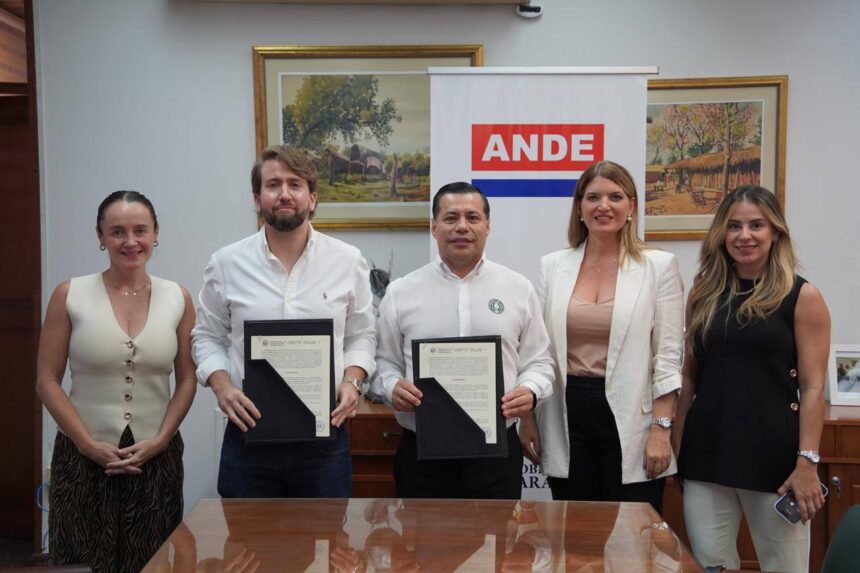
Paraguay’s state-owned electricity company, Administración Nacional de Electricidad (ANDE), has entered into a significant Memorandum of Understanding (MOU) with Morphware, paving the way for a government-driven Bitcoin mining initiative. This program is set to utilize thousands of mining machines that were confiscated from illegal operations, alongside the country’s abundant unused hydroelectric power.
This MOU establishes a formal collaboration between ANDE and Morphware, wherein Morphware will serve as a technical and advisory partner for regulated Bitcoin mining operations within Paraguay. The arrangement will make use of the substantial number of seized bitcoin miners that the Paraguayan authorities have confiscated due to illicit practices across the nation.
Kenso Trabing, the founder and CEO of Morphware, shared insights about the vast quantity of confiscated hardware, noting that the government currently holds approximately 30,000 Bitcoin miners. These have been seized from operators caught illegally tapping electricity or misrepresenting their businesses to qualify for lower energy prices. Trabing described government storage areas filled to capacity with these mining machines.
In recent years, Paraguay has emerged as an attractive location for Bitcoin miners, primarily due to its low-cost hydroelectric energy, much of which is generated by the Itaipu Dam and exported to Brazil. However, this influx of miners has sparked significant concerns regarding electricity theft, with many operators engaging in illegal diversions or misclassifying their activities to evade higher industrial tariffs.
As a result of these practices, authorities undertook enforcement measures that led to the confiscation of a large number of mining rigs. While the government effectively removed these illegal miners from the grid, it found itself in possession of tens of thousands of mining machines and no clear strategy for their use.
The partnership outlined in the MOU seeks to reposition these confiscated miners in utility-controlled locations near substations. Under this plan, ANDE will maintain ownership and oversight of the operations, while Morphware will provide essential training, operational guidance, and technical expertise. Trabing emphasized that Morphware’s role is largely advisory, aiding ANDE staff who have no prior experience in Bitcoin mining.
Plans are underway to transform existing utility facilities into basic mining sites. Many of these structures are located adjacent to substations and could be revamped through modifications such as adding ventilation, transformers, distribution units, and metering equipment. The aim is to convert underutilized electricity into a new revenue stream for the state utility.
Electric power in Paraguay is a highly politicized subject, with various tariff structures for households, favored industries, and mature sectors. Bitcoin mining typically falls under a relatively higher-rate category, but illegal miners often attempt to circumvent these charges. By executing mining operations through state-controlled infrastructure, the government hopes to ensure adherence to regulations while benefiting financially.
A pertinent consideration arising from this initiative is the management of the Bitcoin mined. Trabing indicated that there are ongoing discussions within government bodies regarding the potential uses of mined Bitcoin. Some officials advocate for immediate sales of mined Bitcoin to fund public services such as social security, education, and infrastructure projects. Others have proposed a strategy to hold some Bitcoin or utilize financial markets to mitigate price risk.
Morphware has suggested a cautious approach involving derivatives, such as selling BTC futures on U.S. exchanges, to hedge production and stabilize revenue. Furthermore, the company has advised against direct custody of Bitcoin by government agencies due to previous cybersecurity breaches, including a ransomware attack affecting multiple ministries.
While the MOU centers on Bitcoin mining, it also signifies a broader change in Paraguay’s strategy towards its electricity exports. The nation currently utilizes only a small portion of the energy it generates, with much of it sold abroad at low prices. Bitcoin mining presents a method to exploit excess energy domestically, circumventing the need to rely solely on traditional industrial demand.
As Trabing remarked, “When you do the math, it’s so simple,” pointing out that selling electricity at significantly higher rates through local usage makes more economic sense.
The MOU represents an initial commitment towards this endeavor. The first phase will focus on deploying the confiscated miners and training ANDE personnel on operations, grid integration, and the fundamentals of Bitcoin. If the pilot proves effective, there’s potential to finance new mining equipment via structured financial products linked to future Bitcoin production, rather than depending exclusively on seized hardware. Trabing envisions this initiative as indicative of the future of midstream electricity, where utility grids not only deliver energy but also have a vested interest in the digital infrastructure they support.