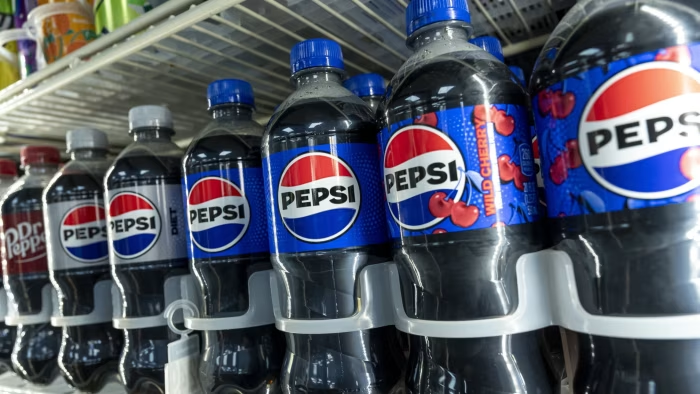
PepsiCo has unveiled a difficult quarter, reporting declining sales volumes in its two primary sectors while simultaneously announcing the impending departure of its chief financial officer, Jamie Caulfield, after a tenure of less than two years. The company, known for popular products like Pepsi and Doritos, disclosed that organic sales volumes in both its North American food and beverage divisions fell 4 percent during the third quarter. This drop appears to reflect a combination of rising prices and heightened health consciousness among consumers, leading to a downturn in purchasing behaviors.
The struggles within PepsiCo’s North American operations have attracted the attention of activist investor Elliott Management, which recently declared a $4 billion stake in the company and has proposed a series of recommendations to revitalize its growth trajectory. This move has intensified the scrutiny on CEO Ramon Laguarta, who faces mounting pressure to reverse the sales slump that has persisted over the last two years.
In a strategic shift, Steve Schmitt, the current finance chief at Walmart’s U.S. division—the largest customer of PepsiCo—will step in to replace Caulfield, starting November 10. In conversations with analysts, Laguarta described his interactions with Elliott as “very constructive and collaborative,” suggesting a willingness to engage further as they consider the firm’s proposals. He indicated that many of the strategies laid out by Elliott in a 75-page presentation already aligned with PepsiCo’s long-term vision.
Laguarta asserted, “PepsiCo is undervalued, and there’s a lot of opportunities to improve the valuation of the company” through prompt and decisive measures. Elliott has yet to respond publicly to the recent quarterly results, but PepsiCo has indicated several specific factors contributing to its volume declines. These include a transition to a new production and distribution contractor, particularly regarding Aquafina water packaging, as well as the absence of certain promotional pricing that was available in the same quarter last year.
Despite the challenges, PepsiCo reported a net revenue increase of 2.7 percent to $23.9 billion, which slightly surpassed analysts’ consensus estimates. This growth was primarily driven by price increases, although net profit experienced a decline, falling 11 percent to $2.6 billion—significantly lower than the projected $3.1 billion, owing to increased costs and an impairment charge related to the Rockstar energy drink brand. The company has recently sold the U.S. and Canadian segments of Rockstar to beverage firm Celsius, further impacting financial outcomes.
In response to shifting consumer preferences, PepsiCo has been active in launching healthier product options. Laguarta mentioned the company’s commitment to reformulating popular snack items like Lay’s and Tostitos without artificial colors or flavors, as well as fortifying brands such as Doritos with added protein to meet consumer demand. However, amid these efforts, PepsiCo’s stock has seen a decline of 7 percent this year, contrasting sharply with a 7 percent increase for rival Coca-Cola and a 15 percent rise in the S&P 500 index.
As the market landscape evolves, the effectiveness of PepsiCo’s strategic pivots and its responses to investor pressures remains to be seen, making the upcoming quarters critical for the food and beverage giant.