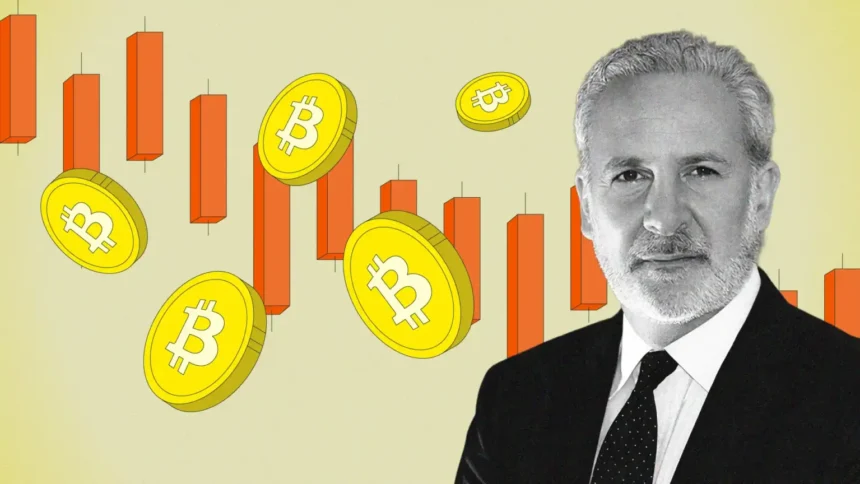
Bitcoin is facing renewed scrutiny as its performance continues to lag, with notable criticism from long-time gold advocate Peter Schiff. Schiff attributes Bitcoin’s recent struggles to the increasing involvement of institutional investors from Wall Street. His comments come amidst a backdrop of soaring precious metals prices and growing concerns that Bitcoin’s current trajectory mirrors the bear market experienced in early 2022.
In a series of posts on X, Schiff pointed out that Bitcoin thrived when it had not yet attracted significant institutional interest, suggesting that its transition into the mainstream market has led to a decline in performance. “Bitcoin was the best performing asset during a time period when hardly anyone owned it,” he noted, adding that since its peak in November 2021, Bitcoin has dropped over 50% in value compared to gold. This decline highlights Schiff’s sentiment that the cryptocurrency has not kept pace with the upward trend of precious metals, which have recently reached record highs.
As gold and silver prices soar, Schiff illustrates a shift toward what he deems “real money.” He expressed concern for Bitcoin holders, stating that the long-term holders may be missing out on significant gains available in the precious metals market. Schiff mentioned the surge in precious metals mining stocks and predicts rapid price appreciation in that sector, further contrasting these gains with Bitcoin’s recent downturn.
The discussion around Bitcoin’s market performance has led to comparisons with the early months of 2022, when tightening monetary policies and economic uncertainty led to a drastic sell-off in the cryptocurrency market. During that year, Bitcoin experienced a staggering loss of over 60% in value amid rising interest rates and widespread liquidity issues, causing several prominent crypto firms to collapse.
However, not all analysts are convinced that the current market situation is indicative of another bear market like 2022. Some experts argue that the macroeconomic conditions are substantially different now than they were two years ago. Crypto analyst Garret Bullish stressed that while short-term price patterns may appear similar, the broader context is essential. He indicated that the current economic climate is characterized by falling inflation rates and increased liquidity from central banks, contrasting sharply with the environment of 2022.
Bullish also highlighted advancements in technology, particularly in artificial intelligence, as factors that could enhance the likelihood of long-term disinflation. He argued that historically, Bitcoin tends to perform better during these periods of disinflation, thus suggesting that long-term outlooks for Bitcoin should not be overshadowed by recent price movements.
As the cryptocurrency market continues to grapple with these varying perspectives, the debate over Bitcoin’s place in the financial landscape intensifies, underscoring the complexities of market dynamics and investor sentiment.