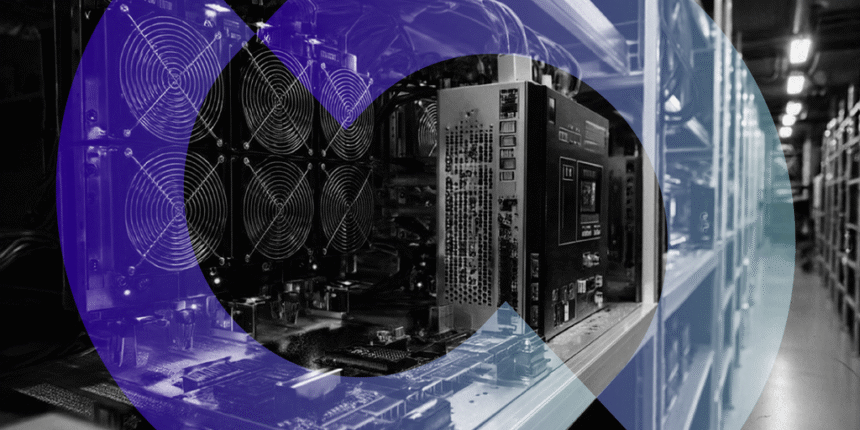
Postquant Labs has unveiled the Quip Network, a groundbreaking blockchain testnet that enables mining through both quantum computers and traditional hardware. This innovative platform shifts away from conventional Bitcoin-style hashing, opting instead for optimization challenges grounded in the Ising model. The company asserts that this network not only allows for mining but also serves as a means to monitor advancements in quantum computing’s potential to undermine Bitcoin’s cryptographic measures.
In a significant leap for the integration of quantum technology in cryptocurrency, Postquant Labs partnered with D-Wave Quantum Inc. to facilitate parts of Quip Network’s proof-of-work operations on D-Wave’s Quantum Advantage2 annealing quantum computers, boasting the testnet as the first publicly accessible quantum-classical blockchain.
Richard Carback, CTO and co-founder of Postquant Labs, explained that instead of engaging in the hashcash problem associated with Bitcoin mining, miners on the Quip Network tackle Ising model optimization problems. This mathematical framework aligns a given challenge with an Ising-type energy function, where the goal is to discover the lowest-energy configuration of binary variables. Such problems are notably more difficult for traditional computers but are ideal for quantum processors, which can execute these calculations substantially quicker.
Participants in the network, called miners, are rewarded with QUIP tokens for their efforts. These tokens serve as a form of currency intended to rent time on the quantum computers that are integrated with the network. Colton Dillion, CEO and co-founder, drew parallels with Bittensor’s TAO network, emphasizing that Quip Network similarly incentivizes users for contributing computational resources, albeit through the mining of QUIP tokens aimed at future rental use of quantum computing capabilities.
One appealing aspect of the Quip Network is its potential to diminish the energy consumption associated with mining. Dillion estimated that approximately 13 watts of electricity would be required to mine a block using quantum technology—comparable to the energy consumption of a light bulb over the course of an hour. This reduction in energy has become particularly relevant given the criticism facing Bitcoin mining for its substantial electricity demands.
However, challenges remain, particularly regarding the availability of quantum hardware. While traditional GPUs are accessible for a variety of applications—including gaming and crypto mining—quantum systems are largely confined to corporate labs and academic institutions. Trevor Lanting, chief development officer at D-Wave Systems, emphasized that while quantum processors can act as accelerators for specific tasks, they are not likely to replace classical hardware outright. He noted ongoing commercial applications utilizing D-Wave’s quantum technology, suggesting a gradual integration rather than a drastic shift in the industry.
Alongside practical mining applications, concerns surrounding security are paramount. Experts have increasingly highlighted the impending “Q-Day”—the moment when quantum computers may possess sufficient power to compromise the public-key cryptography foundations supporting various online systems, including Bitcoin and Ethereum. As the technology advances, the risk of quantum machines being able to derive private keys could pose significant threats to existing cryptocurrencies.
The Quip Network aims to address these security considerations by using a future iteration of its system to assess the progress made toward breaking elliptic curve cryptography, a key protective measure for Bitcoin wallets. Carback encouraged current Bitcoin miners to persist with their activities while advocating the use of post-quantum wallets for enhanced security, promising ongoing updates on developments in the quantum landscape.