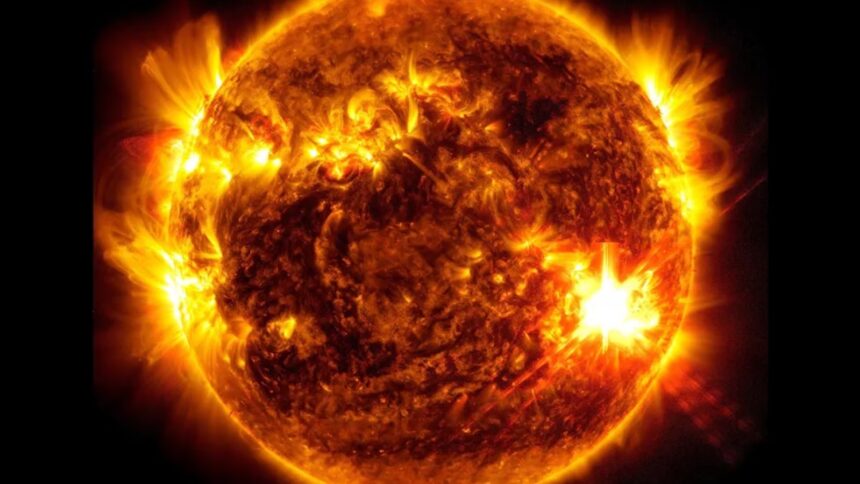
A powerful solar eruption is anticipated to impact Earth soon, as indicated by forecasts from the National Oceanic and Atmospheric Administration’s (NOAA) Space Weather Prediction Center. The event, known as a coronal mass ejection (CME), is expected to arrive between early and midday Tuesday. This CME is linked to an M8.1 solar flare and may escalate geomagnetic activity to levels that could produce a G3 storm, marking it as the third level on the Space Weather Scale.
Geomagnetic storms at this intensity are classified as “strong” and can introduce minor complications in technology, including disruptions to satellites and radio communications. Of particular interest is that solar activity could lead to exceptionally vibrant auroras, which may allow the northern lights to be visible across a broader swath of the U.S. This includes many northern states as well as parts of the lower Midwest extending to Oregon.
Space weather, while often overshadowed by terrestrial meteorological conditions, is significantly influenced by solar activity. It refers to the environment in space and how solar phenomena impact various objects throughout the solar system, including Earth and its orbiting satellites. NASA elaborates that the sun powers itself through nuclear fusion, releasing high-energy charged particles and bursts of radiation that can disrupt conditions in space.
The protective magnetic field and atmosphere of Earth guard against the most hazardous outcomes of solar activity. However, interactions between solar wind and Earth’s magnetosphere can result in beautiful auroras, like the northern lights, but can also cause systemic damage to a range of technologies. This includes communication systems, GPS, and power grids.
In recent months, solar activity has been notably high. The sun reached its solar maximum in October 2024, a phase in its 11-year cycle characterized by increased solar flares. Detectable repercussions from the sun’s activity have ensued, including a warning from Airbus in late November that solar storms could “corrupt data critical to the functioning of flight controls.” This serves as a reminder of the far-reaching impacts of solar activity.
Both NASA and NOAA are engaged in monitoring space weather, but the NOAA Space Weather Prediction Center specializes in forecasting events that can impact life on Earth and the technologies it relies upon. It monitors a variety of solar phenomena including geomagnetic storms, solar radiation storms, solar flares, and sunspots, using NOAA Space Weather Scales to communicate current and anticipated conditions.
Geomagnetic storms are particularly noteworthy due to their implications for technology. They can interrupt communication systems, affect GPS functionality, and strain power grids. These storms are usually driven by CMEs, which release vast amounts of charged particles that collide with Earth’s magnetic field. NOAA classifies geomagnetic storm intensity on the G-scale from G1 (minor) to G5 (extreme).
Historically significant geomagnetic storms include one in May 2024, which caused disruptions ranging from tripped high-voltage lines to GPS-guided agricultural equipment going off course. Furthermore, a noteworthy wave of solar activity occurred in late October 2003, affecting power grids and aviation systems due to its extensive reach. The event resulted in auroras that were observable even in southern states like Texas and Florida.
Most recently, early Monday saw a strong solar flare categorized as an R3 radio blackout event impacting Australia and parts of Southeast Asia. It created significant radio communication disruptions for roughly an hour on the sunlit side of the Earth, highlighting the ongoing relevance and impact of solar phenomena on our technologies and everyday life.