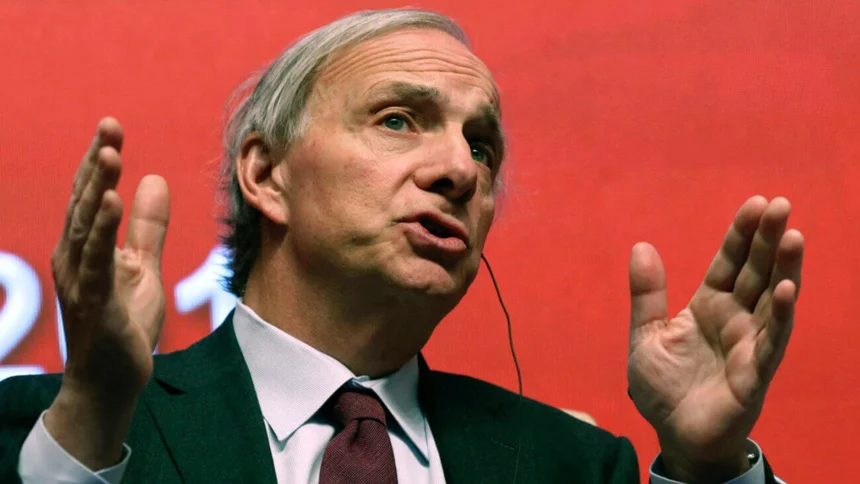
Billionaire investor Ray Dalio has raised concerns regarding the Federal Reserve’s decision to halt quantitative tightening and resume balance-sheet expansion, suggesting these moves could significantly impact financial markets, particularly for gold and Bitcoin. Dalio posits that the Fed’s actions may lead to what he describes as ‘financial-asset inflation,’ a phenomenon where assets like gold often see a price increase. This perspective aligns with recent comments from former BitMEX CEO Arthur Hayes, who expressed optimism that the Fed’s quantitative easing might “reignite the Bitcoin bull market.”
In a recent essay, Dalio underscored the importance of the Fed’s policy shift, noting that while it may appear to be a mere adjustment, it could signify a broader move towards more accommodating monetary policies. He highlighted remarks from Fed Chairman Jerome Powell, emphasizing the need for reserve levels to grow in response to the expanding banking system and economy. Dalio cautioned that any increase in the Fed’s balance sheet, coupled with reduced interest rates and continuing fiscal deficits, could be interpreted as a maneuver to monetize government debt, potentially contributing to an economic bubble.
Elaborating on the impact of this liquidity, Dalio explained that when central banks purchase bonds, they generate additional liquidity, lowering real interest rates. He articulated a cycle wherein this liquidity flows into financial assets, leading to elevated asset prices and diminished real yields, ultimately resulting in a rise in gold prices. He directly linked money creation with gold’s performance, arguing that higher inflation typically benefits hard assets, with limited supply of gold exacerbating the effect.
While Dalio primarily discussed gold, he pointed to broader implications for other assets, including Bitcoin. Support for this perspective comes from Arthur Hayes, who indicated that the Fed’s monetary policies are already facilitating a resurgence in Bitcoin’s price. In a recent analysis, Hayes described the Fed’s strategies as akin to “stealth quantitative easing,” suggesting that it is quietly infusing dollars into the market, which he believes could trigger a new bull run for Bitcoin. He argued that as the Fed’s balance sheet expands, it creates liquidity that would likely boost the prices of Bitcoin and other cryptocurrencies.
However, caution persists in the market. Analyst Valdrin Tahiri from CCN has tempered the enthusiasm surrounding Bitcoin with warnings about its current technical setup. Tahiri noted that Bitcoin has been exhibiting signs of weakness, indicating a potential protracted correction rather than an imminent surge. He highlighted that Bitcoin is precariously sitting near a critical support level around $106,000, and a decisive drop below this threshold could lead to a decline exceeding 20 percent. Furthermore, he observed that the total market capitalization falling below $3.55 trillion suggests that the bullish cycle might have reached its apex.
As of the latest data, Bitcoin is trading just below $102,000, and analysts are closely monitoring these developments as the intersection of monetary policy and cryptocurrency markets unfolds.