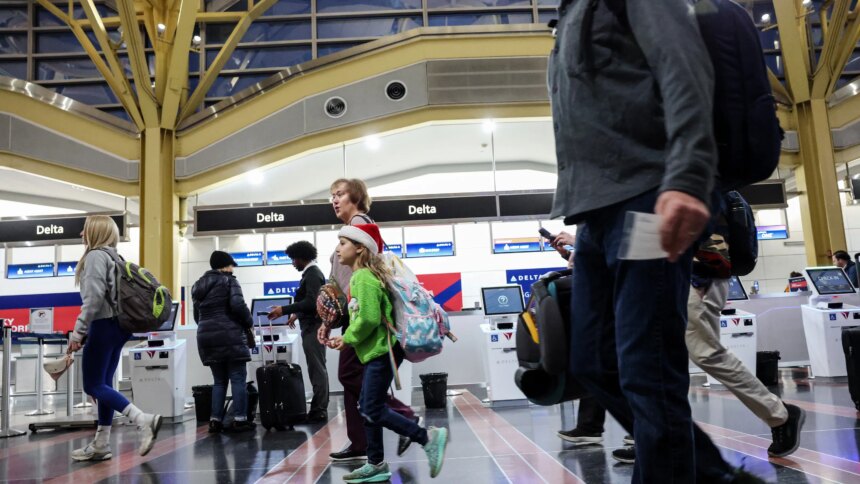
The upcoming winter holiday travel season is poised to set new records, with an estimated 122.4 million Americans planning to travel between December 20 and January 1, surpassing last year’s figure of 119.7 million. The American Automobile Association (AAA) highlights that while a significant portion of travelers will choose road trips, approximately 8.03 million individuals will opt for air travel, noting a surge in cruising demand, which has risen by 25% since 2019.
Stacey Barber, vice president of AAA Travel, emphasized the diversity of travel experiences during this festive period, stating, “Holiday celebrations look different for everyone, but a common thread is the desire to travel, whether it’s returning to your hometown or exploring new destinations.”
In terms of flight costs, travelers should brace themselves for higher prices this season. The average domestic round-trip flight is currently around $900, reflecting a 7% increase compared to 2024. The days leading up to Christmas and New Year’s are expected to be particularly expensive, with prices showing greater stability than in the previous year due to a limited number of seats available among budget airlines.
For those considering destinations, warm-weather locales such as Orlando, Fort Lauderdale, and Miami are the most sought-after by domestic travelers, followed closely by Anaheim, California, and Honolulu, Hawaii. On the international front, popular destinations include tropical spots like Cancun, Punta Cana, Cozumel, and San Jose, Costa Rica.
Travelers planning to drive during the holiday season are advised to be strategic. Historically, traffic is lightest on Christmas Eve, Christmas Day, New Year’s Eve, and New Year’s Day. To avoid heavy congestion, it’s recommended to refrain from driving after 9 p.m. on December 20 and before 1 p.m. from December 21 to 23. After Christmas, lesser traffic is expected before 11 a.m. from December 26 to 28 and before 10 a.m. on December 29 and 30.
However, travelers should be prepared for significant delays during the busiest travel periods. According to INRIX data, the week leading up to Christmas will see more traffic than the week following it. The busiest times are projected to be between noon and 8 p.m. on December 20, and 1 p.m. to 7 p.m. from December 21 to 23.
Specific congestion hotspots across major U.S. cities have been identified, indicating substantial travel time increases on popular routes. For example:
- Atlanta: Heavy traffic is expected from Atlanta to Augusta via I-20 E, particularly on December 22 at 3:15 p.m., with an estimated travel time of over three hours—51% longer than usual.
- Boston: Drivers traveling from Boston to Portsmouth via I-95 are advised to steer clear on December 20 at 3:30 p.m., where travel time could increase by 126%.
- Denver: Expect delays on December 26 when traveling from Fort Collins to Denver, especially around 12:45 p.m., with a potential travel increase of 97%.
- Houston: Those traveling from Galveston to Houston face a significant slowdown on December 23 at 5:45 p.m.
- Los Angeles: Travelers from Los Angeles to Palm Springs should avoid the route on December 26 at 5:45 p.m. to minimize delays.
- New York: Heavy congestion on the Long Island Expressway is anticipated on December 22 around 4:15 p.m., with travel times jumping by over 90%.
- San Francisco: A careful approach is suggested for those driving to Sacramento on December 23 at 5 p.m., where delays could be substantial.
- Washington, D.C.: The route from Washington to Baltimore via the Baltimore-Washington Parkway is expected to be particularly congested on December 20 at 4:15 p.m., with travel times more than doubling.
With a record number of travelers hitting the roads and skies this holiday season, both careful planning and a sense of patience will be essential to navigate the busy travel landscape effectively.