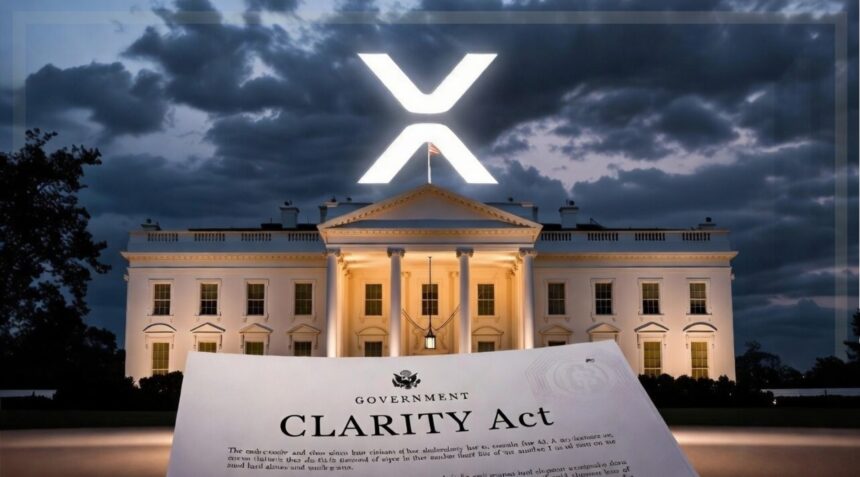
The March 1 deadline for drafting the CLARITY Act has come and gone, leaving many in the cryptocurrency community eagerly awaiting the Senate’s vote. Currently, the legislation remains unpassed, and XRP, often viewed as a key player in the cryptocurrency space, finds itself in a precarious position that could significantly shift depending on the bill’s outcome.
As of early March 2026, XRP’s value hovers around $1.37, a considerable drop from its January peak of $2.40 and over 60% below its 2025 all-time high of $3.65. While these figures might paint a bleak picture, a closer examination of the potential legislative implications reveals a more complex landscape. Should the Digital Asset Market CLARITY Act (H.R. 3633) successfully navigate through the Senate and be signed into law by President Trump, XRP could see a structural re-evaluation that might enhance its market position.
At its core, the CLARITY Act aims to resolve the ongoing jurisdictional conflicts between the Securities and Exchange Commission (SEC) and the Commodity Futures Trading Commission (CFTC) over digital assets. By establishing clear definitions, the Act proposes that digital commodities fall under the CFTC’s purview, while investment contract assets would remain with the SEC. For XRP, a successful passage of the CLARITY Act would officially categorize it as a digital commodity under federal law. This clarification could eliminate significant barriers that have hindered banks, asset managers, and payment providers from utilizing XRP in their operations.
Despite the momentum the CLARITY Act initially gained—passing the House in July 2025 with bipartisan support leading to a 294-134 vote—the bill experienced setbacks when key industry players withdrew their backing in January 2026. This withdrawal led to delays in committee markups, and no new dates have been announced since. Following this situation, the White House set a March 1 drafting deadline to facilitate discussions around the bill and other related market structure issues. However, this was not intended as a deadline for a vote or a signing, leading to concerns about the Act’s progression.
Ripple CEO Brad Garlinghouse remains optimistic about the bill’s future, estimating an 80% chance of its passage by the end of April. He cites renewed energy and focus in Washington as encouraging signs that the industry can no longer afford to remain in a state of regulatory ambiguity. Ripple has been proactive in the financial landscape, with significant investments in infrastructure—spending over $2.4 billion on acquisitions in 2025 alone. These moves are aimed at creating strong networks that could integrate with traditional finance upon obtaining regulatory clarity.
Meanwhile, the surge in XRP’s ETF inflows—totalling over $1.3 billion within just weeks of the Canary Capital spot XRP ETF launch—indicates a growing institutional interest, despite recent outflows raising red flags among analysts. Standard Chartered has even adjusted its XRP price projections significantly, slashing its 2026 price target from $8 to $2.80, though it holds a long-term bullish outlook of $28 for 2030.
A critical point of contention is the structural tension resulting from the CLARITY Act’s provisions. Under Section 205, to qualify as a “Mature Blockchain System,” certain governance criteria must be met. Ripple currently holds about 34% of the total XRP supply in escrow, potentially requiring restructuring to meet the proposed 20% cap outlined in the Act, complicating its path to regulatory approval.
As 2026 unfolds, various models project XRP’s year-end price ranging between $3 and $10, depending on ETF trends and market sentiment, while more optimistic scenarios that anticipate the Act’s passage could see XRP valued between $15 and $30. Polymarket odds for the Act’s enactment have surged to approximately 70-72%, reflecting a renewed sense of urgency following the March deadline.
The clock is ticking for the CLARITY Act as the midterm election season approaches, complicating the likelihood of passing new legislation. Industry experts emphasize that if the Act does not clear before this political cycle intensifies, the opportunity for its passage could vanish. XRP has endured years of legal uncertainty; now, the interplay of legislative developments, ETF market activity, and traditional finance’s acceptance becomes crucial as the cryptocurrency landscape evolves. As all eyes remain fixed on the Senate, the summer months will be critical for XRP and the future of digital asset regulation.